
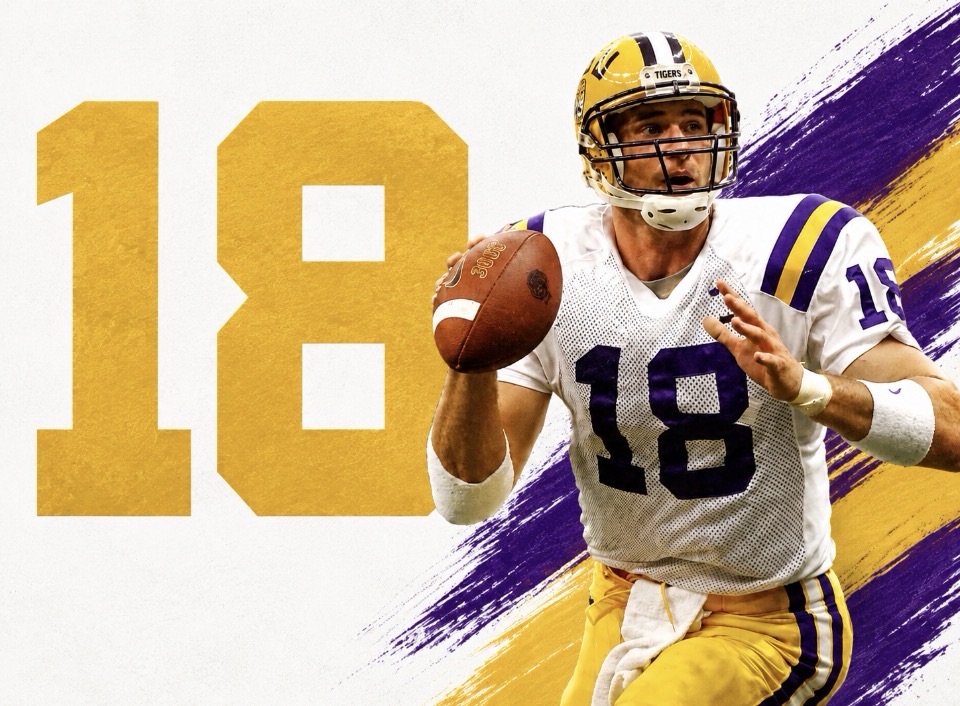
At LSU, some jersey numbers become famous because of the superstar who wore them.
No. 18 is just different.
You do not have to be LSU’s best player to wear it. You have to be the kind of player LSU wants representing the program.
For more than two decades, No. 18 has represented leadership, toughness, selflessness, accountability, character and a willingness to put LSU ahead of yourself. It has been worn by quarterbacks, running backs, tight ends, defensive linemen, linebackers, defensive backs, an offensive lineman and even a kicker.
The position does not matter.
The person does.
And the tradition begins with Matt Mauck.
Mauck wore No. 18 from 2001 through 2003, but the jersey took on a completely different meaning during his final season. In 2003, Mauck quarterbacked LSU to its first national championship since 1958. The Tigers finished the season by defeating Oklahoma 21-14 in the BCS National Championship Game.
Mauck became everything LSU wanted its players to represent: successful, mature, dependable and selfless.
When his LSU career ended, Mauck wanted No. 18 to go to another player who represented those same qualities. With help from members of LSU’s football staff, the number was passed to freshman running back Jacob Hester.
The choice was about much more than football.
Mauck later explained that Hester was active in his community, performed well in the classroom and conducted himself with maturity. The idea was not originally intended to become a major LSU tradition. Mauck said it was supposed to be something for the players inside the locker room.
Hester changed that.
He wore No. 18 for four seasons from 2004 through 2007 and became one of the most respected players on LSU’s roster. He was tough, dependable and willing to do whatever the team needed.
Then, in 2007, Hester helped LSU win another national championship.
Now the jersey had a legacy.
The first two men associated with the No. 18 tradition had helped lead LSU to national championships.
From that point forward, No. 18 became one of the greatest individual honors in LSU football.
LSU has described the recipient as the player who best exemplifies what it means to be an LSU football player on and off the field. Through the years, coaches have emphasized leadership, attention to detail, attitude, intelligence, grit, academic responsibility, community involvement and the ability to remain dependable when adversity arrives.
The No. 18 is supposed to be the teammate everyone can count on.
That is why the honor is different from LSU’s famous No. 7 tradition.
No. 7 has traditionally been associated with extraordinary talent and playmaking ability.
No. 18 is about something deeper.
It is about trust.
It is about the player coaches want younger Tigers watching.
It is about the man teammates want beside them when LSU is trying to protect a lead, finish a fourth-quarter drive, survive a difficult season or respond when things go wrong.
The tradition has also evolved.
For years, there was one No. 18. In 2017, LSU expanded the tradition when defensive lineman Christian LaCouture and fullback/tight end John David Moore shared the honor.
LSU did it again in 2019 with linebacker K’Lavon Chaisson and center Lloyd Cushenberry III. Because NCAA numbering rules prevented an offensive lineman from actually wearing No. 18 in games, Cushenberry wore his normal No. 79 with an No. 18 patch.
That pair helped lead LSU to a 15-0 national championship season.
Think about the history attached to the number.
Mauck was part of the 2003 national championship.
Hester was part of the 2007 national championship.
Chaisson and Cushenberry were leaders on the undefeated 2019 national championship team.
That is a remarkable championship lineage for a jersey that is awarded primarily because of character and leadership.
The list also includes some outstanding LSU players.
Tre’Davious White received the honor for two seasons in 2015 and 2016.
Foster Moreau wore it in 2018.
Damone Clark wore No. 18 in both 2020 and 2021.
BJ Ojulari received it in 2022.
Mekhi Wingo was selected in 2023 after establishing himself as one of LSU’s strongest leaders on and off the field.
In 2024, running back Josh Williams and linebacker Greg Penn III shared the honor. Williams had arrived at LSU as a walk-on and developed into a veteran leader, while Penn had become one of the most dependable players on LSU’s defense.
Then the number returned to quarterback in 2025.
Garrett Nussmeier wore No. 18 during his fifth and final LSU season, making him the first LSU quarterback to wear the number since Mauck.
More than two decades after the tradition began with a quarterback, No. 18 had come back to the position where it started.
The significance of the tradition now extends beyond Baton Rouge. An LSU No. 18 jersey has been displayed at the College Football Hall of Fame.
That is what the number has become.
It is no longer simply part of LSU’s uniform.
It is part of LSU football history.
LSU’s No. 18s
2001-2003 — Matt Mauck, QB
2004-2007 — Jacob Hester, RB
2008-2009 — Richard Dickson, TE
2010 — Richard Murphy, RB
2011 — Brandon Taylor, S
2012 — Bennie Logan, DT
2013 — Lamin Barrow, LB
2014 — Terrance Magee, RB
2015-2016 — Tre’Davious White, CB
2017 — Christian LaCouture, DL
2017 — John David “J.D.” Moore, FB/TE
2018 — Foster Moreau, TE
2019 — K’Lavon Chaisson, OLB
2019 — Lloyd Cushenberry III, C
2020 — Chris Curry, RB
2020-2021 — Damone Clark, LB
2021 — Avery Atkins, K/P
2022 — BJ Ojulari, DE
2023 — Mekhi Wingo, DT
2024 — Josh Williams, RB
2024 — Greg Penn III, LB
2025 — Garrett Nussmeier, QB
As of August 9, 2026, LSU’s official roster does not list a player wearing No. 18.
That means the next chapter has not yet been written.
Whoever receives it next will inherit much more than a jersey.
He will inherit Mauck and Hester.
He will inherit White, Moreau, Chaisson, Cushenberry, Clark, Ojulari and Wingo.
He will inherit national championships, leadership and more than two decades of expectations.
At LSU, plenty of players can become stars.
Only a few are trusted with No. 18.

