
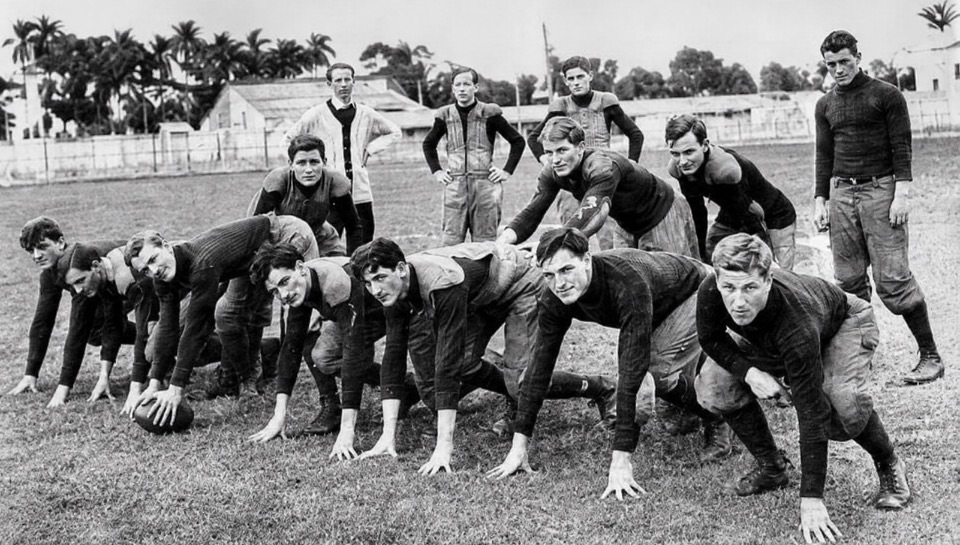
Long before bowl games, charter flights and the College Football Playoff, LSU ended its 1907 football season by doing something extraordinary for the time: the Tigers traveled to Havana, Cuba, to play the University of Havana on Christmas Day. LSU’s own historical records identify the game as the first time an American college football team played on foreign soil. The trip was more than a football curiosity. LSU already had academic and cultural ties to Cuba, and the game gave the university a chance to strengthen those connections.
The 1907 Tigers were a good team that was about to become a great one. Edgar Wingard was in his first season as LSU’s head coach, and George “Doc” Fenton was in his first season with the Tigers. LSU opened with a 28-0 win over Louisiana Industrial before losing at Texas, 12-5, and Texas A&M, 11-5. The Tigers then put together a four-game winning streak that included victories over Arkansas and Ole Miss. Alabama edged LSU 6-4, but the Tigers answered by crushing Baylor 48-0. LSU entered the Cuba trip with a 6-3 record and would finish the season 7-3 after the game in Havana.
The football being played in 1907 looked very different from the modern game. Teams had only three downs to gain 10 yards. Touchdowns were worth five points instead of six. The field was 110 yards long instead of 100. The forward pass had only been legalized the year before and was still used cautiously under restrictive rules. Punting and field position were major parts of strategy, and players routinely stayed on the field for both offense and defense. It was a lower-scoring, far more physical style of football. That makes LSU’s performance in Havana even more impressive.
The game almost never happened.
After LSU arrived in Cuba, the independent promoter who had arranged the contest backed out. The Tigers had traveled hundreds of miles only to find the event in jeopardy.
Local supporters in Havana stepped in and helped save the game.
By the time LSU and the University of Havana finally took the field at Almendares Park, the contest had become a major local event. LSU’s historical account says tickets reportedly sold for $10, an enormous price for 1907. The crowd included Cuban government officials, members of Havana society and American servicemen.
Then LSU took control.
The Tigers won 56-0.
That score is remarkable even by modern standards, but under 1907 rules it was even more overwhelming. LSU scored 10 touchdowns in a game when touchdowns were worth only five points.
The Tigers were simply too experienced, too physical and too talented for Havana.
One of the game’s biggest plays came from John J. “Bill” Seip, who returned a punt 67 yards for a touchdown. In an era when special teams and field position carried enormous importance, a return of that length was a devastating play.
LSU kept scoring while its defense refused to allow Havana to reach the scoreboard.
The final margin told the story: LSU 56, University of Havana 0.
There are later accounts that describe Doc Fenton as dazzling the Cuban crowd with his speed and elusiveness, and those stories fit the player he was becoming. But the surviving official LSU account does not provide a detailed individual statistical line for Fenton in the Havana game, so the safest conclusion is simply that he was one of the central figures on a team loaded with momentum.
What is certain is what came next.
The Cuba game ended LSU’s 1907 season at 7-3 overall and 2-1 in Southern Intercollegiate Athletic Association play. It also gave Wingard’s team one more game, one more trip and one more chance to develop before the following season.
In 1908, LSU exploded into national prominence.
The Tigers went 10-0, scored 442 points and allowed only 11. Fenton became one of the great stars of Southern football, and LSU produced one of the most dominant seasons in school history.
That makes the Havana game more than a strange footnote.
It was the final game before LSU’s first legendary team.
Picture the scene.
Christmas Day, 1907.
Havana, Cuba.
No Tiger Stadium. No radio broadcast. No television. No facemasks. Three downs to gain 10 yards. Five-point touchdowns. A 110-yard field.
And LSU playing football in another country before thousands of spectators.
The Tigers did not just win.
They overwhelmed Havana, 56-0, and closed the season with one of the most unusual victories in LSU football history.
More than a century later, LSU has played in national championship games, major bowls and stadiums across the country.
But only one LSU team can say it was the first to take the Tigers abroad.
And it happened on Christmas Day in Cuba.

