
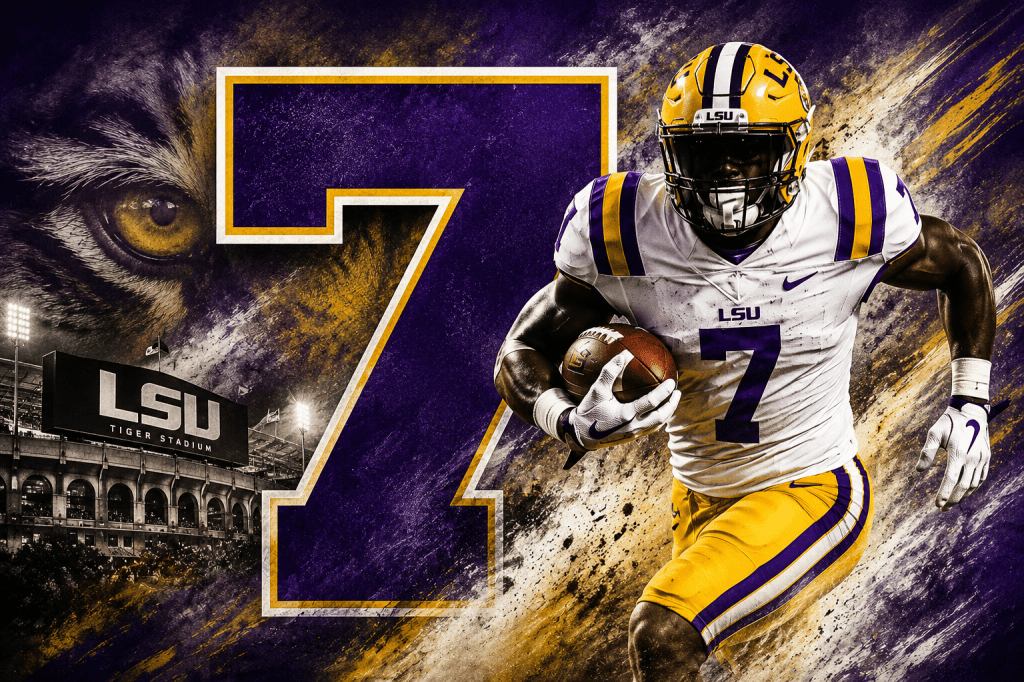
At LSU, No. 7 is not just another jersey number.
It is the number of THE playmaker.
The jersey has been worn by All-Americans, national champions, major award winners and some of the most recognizable players in LSU football history. Quarterbacks, linebackers, cornerbacks, safeties, running backs and wide receivers have worn it. LSU has even expanded the tradition to honor an offensive lineman who could not physically wear No. 7 under NCAA numbering rules.
The position can change.
The expectation does not.
Make plays. Lead. Win.
The history of No. 7 at LSU began long before it became an annual honor. One of the greatest quarterbacks in school history, Bert Jones, wore the number from 1970 through 1972.
Nicknamed “The Ruston Rifle,” Jones became LSU’s first consensus All-America quarterback in 1972. That season he passed for a then-school-record 1,446 yards and 14 touchdowns, was named National Player of the Year by The Sporting News and finished fourth in the Heisman Trophy voting.
Jones left LSU as the school’s career leader in passing yards with 3,255, along with records at the time for attempts with 418, completions with 220 and touchdown passes with 28. He also led the SEC in passing as both a junior and senior.
More than half a century later, LSU announced that Jones’ No. 7 jersey will be retired during the Tigers’ game against Texas in Tiger Stadium on November 14, 2026.
But Jones was not the only great Tiger to make No. 7 famous before it became a tradition.
Linebacker Ali Highsmith wore No. 7 from 2004 through 2007 and became one of the leaders of LSU’s defense.
Highsmith played in 52 games and made 38 starts. He finished his LSU career with 260 tackles, 26 tackles for loss and 11 sacks. As a senior in 2007, he recorded 101 tackles and earned first-team All-America recognition from CBS Sports and second-team honors from the Associated Press.
Most importantly, Highsmith was a major part of LSU’s 2007 national championship team. In the BCS National Championship Game against Ohio State, he led LSU with eight tackles, added 1.5 sacks and forced a fumble.
No. 7 already had serious history attached to it.
Then Patrick Peterson changed everything.
Peterson wore No. 7 from 2008 through 2010 and transformed the jersey from a number worn by great LSU players into one future LSU stars wanted to earn.
LSU officially dates its modern No. 7 tradition to Peterson in 2008.
Peterson was an extraordinary combination of size, speed and athletic ability. He could shut down receivers at cornerback and change games as a return specialist.
His 2010 season established the standard.
Peterson was a unanimous All-American and won both the Jim Thorpe Award as the nation’s top defensive back and the Chuck Bednarik Award as the nation’s top defensive player.
After Peterson, No. 7 was no longer simply a uniform number.
It was the playmaker’s jersey.
Tyrann Mathieu took it next in 2011 and made the number even more famous.
The Honey Badger became one of the most disruptive defensive players in college football. He forced turnovers, returned punts and had an extraordinary ability to make a huge play when LSU needed one.
Mathieu was a unanimous first-team All-American and won the Bednarik Award. He finished fifth in the Heisman Trophy voting with 327 points and 34 first-place votes. LSU went 13-0 through the SEC Championship Game before finishing 13-1.
Mathieu created 14 turnovers during only two seasons at LSU and set the school record with 11 career forced fumbles.
By then, there was no question what No. 7 represented.
Leonard Fournette wore No. 7 from 2014 through 2016 and brought the tradition to offense.
His 2015 season was one of the greatest ever by an LSU running back. Fournette rushed for a then-school-record 1,953 yards and 22 touchdowns while averaging 6.5 yards per carry. He earned consensus All-America honors.
Opposing defenses knew Fournette was getting the football.
They often could not stop him anyway.
That was No. 7.
DJ Chark inherited the jersey in 2017.
Chark gave the number another dimension. As a wide receiver and return specialist, he possessed the speed to stretch defenses and change games in the return game.
Then came Grant Delpit.
Delpit received No. 7 for the 2019 season after already establishing himself as one of college football’s premier defensive backs. He won the Jim Thorpe Award that season and helped LSU complete a perfect 15-0 season and win the national championship.
No. 7 now had another national championship attached to it.
Ja’Marr Chase was selected to wear No. 7 in 2020.
Few players could have been more deserving.
Chase was coming off one of the greatest receiving seasons in college football history. In 2019, he caught 84 passes for 1,780 yards and 20 touchdowns. He led the nation in receiving yards and touchdown catches, won the Biletnikoff Award and became LSU’s first wide receiver to earn unanimous All-America honors.
Chase was awarded No. 7 for 2020 but opted out before the season and never wore it in a game that year.
Safety JaCoby Stevens subsequently wore No. 7 during the 2020 season.
Derek Stingley Jr. inherited the number in 2021.
By the time Stingley received No. 7, he had already earned first-team All-America recognition in each of his first two seasons. His selection continued the remarkable defensive back lineage of Peterson, Mathieu and Delpit.
Kayshon Boutte received No. 7 in 2022.
Boutte had already demonstrated his big-play ability, including a spectacular performance against Ole Miss in 2020 when he caught 14 passes for an SEC-record 308 yards and three touchdowns.
Then Brian Kelly put his own stamp on the tradition.
In 2023, Kelly awarded the No. 7 honor to Louisiana native and left tackle Will Campbell.
That was a major change.
Campbell was an offensive lineman, and college football numbering rules prevented him from actually wearing No. 7 in games. Instead, he continued wearing No. 66 with a No. 7 patch.
Kelly wanted the honor to emphasize Louisiana roots while also recognizing a position that rarely receives the attention given to running backs, receivers and defensive backs. Kelly pointed out that a left tackle is a playmaker in his own way because he must protect the quarterback on every play.
Campbell received the honor again in 2024.
That season LSU also awarded the actual No. 7 jersey to linebacker Harold Perkins Jr.
Perkins was a natural fit.
As a true freshman in 2022, he recorded 72 tackles, 13 tackles for loss and 7.5 sacks. He earned first-team All-SEC honors from the Associated Press and multiple Freshman All-America honors.
He followed that season with 75 tackles, 13 tackles for loss and 5.5 sacks in 2023.
When Brian Kelly awarded Perkins No. 7, he emphasized that the honor was not just about individual talent. The player also had to elevate the teammates around him.
Perkins wore No. 7 in 2024, although a knee injury ended his season after four games. He returned in 2025 and again wore No. 7, finishing the season with 56 tackles, eight tackles for loss, 4.5 sacks and three interceptions.
By the end of his LSU career, Perkins had accumulated 220 tackles, 35.5 tackles for loss and 17 sacks in 43 games.
The list tells the story.
Bert Jones.
Ali Highsmith.
Patrick Peterson.
Tyrann Mathieu.
Leonard Fournette.
DJ Chark.
Grant Delpit.
Ja’Marr Chase.
Derek Stingley Jr.
Kayshon Boutte.
Will Campbell.
Harold Perkins Jr.
Quarterbacks. Linebackers. Defensive backs. Running backs. Receivers. An offensive tackle.
Different positions.
Different eras.
Same idea.
Be the player who can change the game.
LSU’s No. 7s Since 2000
2000-2003 — No modern No. 7 honoree
2004-2007 — Ali Highsmith, LB
2008-2010 — Patrick Peterson, CB
2011 — Tyrann Mathieu, DB
2012 — No designated No. 7
2013 — No designated No. 7
2014-2016 — Leonard Fournette, RB
2017 — DJ Chark, WR
2018 — No designated No. 7
2019 — Grant Delpit, S
2020 — Ja’Marr Chase, WR, awarded No. 7 but opted out before the season
2020 — JaCoby Stevens, S, wore No. 7 during the season
2021 — Derek Stingley Jr., CB
2022 — Kayshon Boutte, WR
2023 — Will Campbell, OT, No. 7 honoree who wore a No. 7 patch on his No. 66 jersey
2024 — Will Campbell, OT, No. 7 patch
2024 — Harold Perkins Jr., LB, No. 7 jersey
2025 — Harold Perkins Jr., LB, No. 7 jersey
There is an important distinction in that list.
Ali Highsmith wore No. 7 before LSU established the modern tradition. LSU officially dates the No. 7 tradition to Patrick Peterson in 2008.
But the history of the number reaches much further back.
Bert Jones made No. 7 famous at quarterback.
Highsmith wore it while helping LSU win the 2007 national championship.
Peterson established the modern tradition.
Mathieu made it iconic.
Fournette brought it to the offensive backfield.
Delpit carried it during LSU’s perfect 2019 national championship season.
Chase earned it after producing one of the greatest receiving seasons college football has ever seen.
And the generations that followed have kept the standard alive.
No. 18 tells you LSU believes a player represents the program.
No. 7 tells you LSU believes a player can change the game.
When LSU awards someone No. 7, he is not simply getting a jersey number.
He is joining one of the greatest collections of playmakers associated with a single number in college football.


[…] LSU Football Report, Why No. 7 Means More at LSU.LSU Football Report: Why No. 7 Means More at LSU […]
LikeLike
[…] LSU Football Report, Why No. 7 Means More at LSUhttps://lsufootballreport.com/2026/08/10/why-no-7-means-more-at-lsu/ […]
LikeLike