
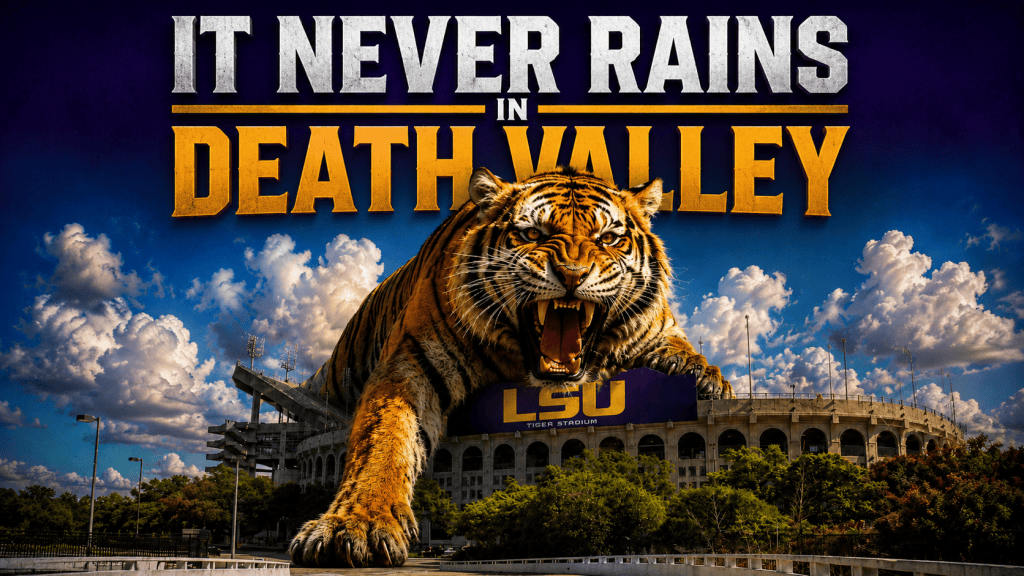
There are stadiums that are loud, stadiums that are historic and stadiums where visiting teams rarely win.
Tiger Stadium is all three.
For more than a century, LSU’s home has stood in the middle of campus as one of the defining venues in college football. It opened with roughly 12,000 seats and grew into a 102,321 seat cathedral where national champions, Heisman Trophy winners and generations of LSU legends have played.
Then the sun goes down.
That is when Tiger Stadium becomes Death Valley.
The reputation is backed by the record book. Since 1958, LSU is 284 wins, 72 losses and four ties in night games at Tiger Stadium, a .794 winning percentage. Since 2000, LSU is 112 and 15 in Saturday night games there, winning 88.2 percent of them. More recently, LSU has gone 30 and 5 at home since 2021, including 24 and 4 at night entering the 2026 season.
That is why Death Valley is more than a nickname.
It is part of LSU football’s identity.
From 12,000 Seats to 102,321
Tiger Stadium opened on November 27, 1924, when LSU hosted Tulane in the final game of the season.
The original stadium was simple by modern standards. East and west sideline stands provided seating for approximately 12,000 fans.
Expansion began almost immediately.
In 1931, LSU extended the east and west stands upward and increased capacity to 22,000. The addition of the north end in 1936 created a horseshoe configuration and pushed capacity to approximately 46,000.
LSU closed the south end in 1953, turning the horseshoe into a bowl and increasing capacity to 67,720.
The west upper deck opened in 1978. The east upper deck followed in 2000. LSU completed another major west side project in 2005.
The south end expansion was completed before the 2014 season and increased official capacity to its current figure of 102,321.
The stadium that once held 12,000 now holds more than eight times that number.
And the basic shape of the old stadium remains buried inside the massive structure LSU fans see today.
Students Once Lived Inside Tiger Stadium
Tiger Stadium has one of the strangest architectural histories in American sports.
Students once lived inside it.
During LSU’s expansion in the 1930s, university officials combined the need for more stadium seating with the need for student housing. Dormitory rooms were constructed beneath portions of the stands.
LSU Athletics says Tiger Stadium once housed approximately 1,500 students. During the fall of 1986, LSU football players even lived in the stadium temporarily while Broussard Hall, then the athletic dormitory, was being renovated.
The old dormitory windows remain visible in portions of the stadium.
It is another reminder that Tiger Stadium was never built all at once. It grew with LSU.
Saturday Night Football Begins
One of the most important dates in Tiger Stadium history came on October 3, 1931.
LSU turned on the stadium lights and played Spring Hill.
The Tigers won 35 to 0.
That game began the tradition that eventually became synonymous with LSU football.
There was a practical reason for playing at night. Many Louisiana fans worked during the day, particularly in agriculture. Evening kickoffs gave supporters from around the state time to finish their work, travel to Baton Rouge and attend the game.
The idea was immediately successful.
LSU’s centennial history notes that LSU drew a larger crowd for the Spring Hill game than undefeated Tulane drew in New Orleans that day against Texas A&M.
LSU had discovered something special.
Football under the lights worked in Louisiana.
Nearly a century later, it still does.
How Tiger Stadium Became Death Valley
The exact moment Tiger Stadium became known as Death Valley is not firmly documented.
That is an important correction to some versions of the story.
LSU Athletics officially lists Tiger Stadium’s nickname as “Death Valley” and dates its use to the 1950s, but LSU does not identify one definitive game, person or event that created the name.
There are old Baton Rouge stories about the stadium being so loud that people sometimes referred to the area with variations on the word “deaf.” There are also conflicting recollections about exactly when those descriptions began.
What can be established is more important than the folklore.
By the middle of the 20th century, Tiger Stadium had developed a reputation for noise, night football and an increasingly difficult home field. “Death Valley” became the name that endured.
And the results eventually made the name feel less like a nickname and more like a description.
Visiting teams came to Baton Rouge.
Most of them lose.
The Numbers Behind Death Valley
Through the 2024 season, LSU’s official Tiger Stadium record stood at:
457 wins
157 losses
18 ties
That is a .737 winning percentage across more than a century of football.
The numbers become considerably more intimidating after dark.
Since 1958:
Night games: 284 wins, 72 losses, four ties
Winning percentage: .794
Day games during the same period:
50 wins, 28 losses, three ties
Winning percentage: .636
Since 2000:
Saturday night games: 112 wins, 15 losses
Winning percentage: .882
And entering 2026, LSU is 30 and 5 at home since 2021.
Of those games, LSU is 24 and 4 at night.
That means LSU has won nearly nine out of every 10 Saturday night games in Death Valley since 2000.
No marketing department created those numbers.
LSU earned them.
Billy Cannon’s Halloween Run
One of the defining moments in the history of Death Valley happened on Halloween night in 1959.
No. 1 LSU hosted No. 3 Ole Miss.
The Tigers trailed 3 to 0 in the fourth quarter when Billy Cannon fielded a punt at the LSU 11 yard line.
Cannon broke seven tackles and raced 89 yards for a touchdown.
LSU took a 7 to 3 lead.
The Tigers still needed a goal line stand in the closing moments to preserve the victory, but Cannon’s run became one of the most famous plays in college football history.
A crowd of approximately 67,500 watched it happen.
Cannon went on to win the Heisman Trophy.
The Halloween Run became LSU legend.
And another layer was added to the mythology of Saturday night in Tiger Stadium.
The Night No. 1 Nearly Fell
September 29, 1979, produced one of the greatest atmospheres in Tiger Stadium history.
Top ranked Southern California came to Baton Rouge with a roster filled with future professional stars.
LSU was a significant underdog.
It did not matter.
The Tigers pushed USC to the final moments before losing 17 to 12. LSU actually held the lead until late in the game.
Thirty years later, LSU’s own retrospective described the crowd as so intense that people trying to listen on radio struggled to hear the broadcast.
LSU did not win.
Death Valley’s reputation grew anyway.
Sometimes a stadium becomes legendary because of victories.
Sometimes it becomes legendary because of what visitors have to survive.
The Night LSU Moved the Earth
October 8, 1988.
LSU hosted No. 4 Auburn.
Auburn led 6 to 0 late in the fourth quarter when LSU quarterback Tommy Hodson drove the Tigers down the field.
LSU eventually faced fourth and 10 from the Auburn 11 yard line.
Hodson found Eddie Fuller in the back of the end zone.
Touchdown.
LSU won 7 to 6.
The crowd of 79,341 erupted so violently that vibrations from the celebration registered on a seismograph operated by LSU’s geology department across campus.
The game became known as the Earthquake Game.
Other stadiums can claim to be loud.
Death Valley once produced scientific evidence.
No. 1 Florida Walks Into Death Valley
October 11, 1997, gave another generation its signature Tiger Stadium memory.
Florida came to Baton Rouge ranked No. 1.
The Gators were defending national champions and had won 25 consecutive SEC games.
LSU was supposed to lose.
Instead, the Tigers beat Florida 28 to 21.
LSU scored two touchdowns within 93 seconds during the fourth quarter to break a 14 to 14 tie. When the game ended, fans flooded the field and both goal posts eventually came down.
Years later, LSU fans voted that victory the greatest night game in Tiger Stadium history.
No. 1 came in.
No. 1 lost.
That is Death Valley.
Alabama’s 31 Year Baton Rouge Streak Ends
November 4, 2000, became another milestone.
LSU had not defeated Alabama in Tiger Stadium since November 1969.
Nick Saban was in his first season as LSU’s head coach.
The Tigers finally ended the drought with a 30 to 28 victory in front of what was then a Tiger Stadium record crowd of 91,778.
Josh Booty threw four touchdown passes, including the winning score to Robert Royal with 5:49 remaining.
Then the goal posts came down.
The victory helped signal the beginning of LSU football’s modern rise.
Three seasons later, LSU was national champion.
2007 Florida: Death Valley at Full Strength
October 6, 2007, provided another perfect example of what Tiger Stadium can become at night.
No. 1 LSU hosted No. 9 Florida.
The Gators led by 10 points entering the fourth quarter.
LSU kept coming.
Jacob Hester carried the Tigers through one fourth down conversion after another. LSU converted all five of its fourth down attempts during the game.
On LSU’s final drive, Hester carried eight times and eventually scored from two yards out with 1:09 remaining.
LSU won 28 to 24.
Hester finished with 106 rushing yards.
The crowd of 92,910 was the largest in Tiger Stadium history at the time.
Veteran CBS announcer Verne Lundquist later said it was the loudest stadium he had ever heard during a broadcast.
LSU won the national championship that season.
But that Florida game remains one of the purest examples of Death Valley influencing a football game.
Sunset Changes Everything
Statistics explain what LSU does at night.
They do not completely explain why.
A Saturday in Baton Rouge begins hours before kickoff.
Tailgates cover campus.
Smoke rises from grills.
Gumbo and jambalaya cook beneath tents.
The Golden Band from Tigerland marches toward the stadium.
Fans pour through the gates.
Then daylight starts disappearing.
The stadium lights take over.
And 102,321 seats begin filling with people wearing purple and gold.
College football writer Dennis Dodd once described LSU’s greatest home weapon in one word:
“Sunset.”
The numbers support him.
LSU wins more often after dark.
Much more often.
“The Sun Has Found Its Home in the Western Sky”
For decades, one voice helped announce the transformation.
Dan Borné served as LSU’s Tiger Stadium public address announcer for 38 years.
As the game moved from the third quarter into the fourth, Borné delivered words that became part of LSU football tradition:
“The sun has found its home in the western sky. It is now Saturday Night in Death Valley!”
Borné retired in 2025 after 38 seasons behind the Tiger Stadium microphone. During his run, LSU won three national championships and six SEC titles.
The announcer changed.
The tradition did not.
102,321 People Become Part of the Game
Tiger Stadium’s official capacity is 102,321.
Capacity alone does not create home field advantage.
Noise does.
Timing does.
Pressure does.
A visiting quarterback walks to the line and tries to change the protection.
The offensive tackle cannot hear him.
The center turns his head.
The play clock keeps moving.
False start.
Now it is first and 15.
The crowd gets louder.
Then comes third down.
That is when 102,321 seats stop being a capacity figure and become a football weapon.
The Rest of College Football Has Noticed
LSU fans are hardly alone in believing Tiger Stadium is special.
In 1998, Sport Magazine named Tiger Stadium the most feared road venue in America. ESPN later called it the scariest place to play in the country.
In 2008, ESPN writer Wright Thompson described it as the best place in the world to watch a sporting event.
The Sporting News later selected Saturday Night in Death Valley as college football’s top game day tradition.
In 2021, Tiger Stadium won a FOX poll as the best Power Five stadium.
Then in 2024, ESPN polled 14 college football writers on the best stadiums in the sport.
Tiger Stadium finished No. 1.
That is a century of reputation being confirmed again and again.
Death Valley Keeps Growing Without Losing Its Soul
Tiger Stadium has changed dramatically since 1924.
Upper decks were added.
Suites arrived.
Video boards grew.
LED lights were installed.
The 2024 renovation brought new video boards, ribbon displays and modern lighting capable of creating in game light shows.
But none of those things created Death Valley.
The crowd did.
Billy Cannon played on the same ground.
Tommy Hodson threw the winning touchdown there.
Kevin Faulk ran there.
Patrick Peterson defended there.
Joe Burrow commanded LSU’s offense there.
Jayden Daniels electrified it.
The players change.
The building evolves.
The intimidation remains.
Why Death Valley Matters
College football has become almost unrecognizable compared with the sport played when Tiger Stadium opened.
Conferences have expanded.
Players transfer freely.
The postseason has grown.
Television increasingly controls kickoff times.
The stadium has modern technology that nobody in 1924 could have imagined.
But one thing has survived every era.
Saturday night in Baton Rouge.
Since 1958, LSU has won almost 80 percent of its night games in Tiger Stadium.
Since 2000, LSU has won more than 88 percent of its Saturday night games there.
Since 2021, LSU has won 24 of 28 night games entering the 2026 season.
That is why opponents practice with artificial crowd noise.
That is why recruits want to see Tiger Stadium full.
That is why LSU fans immediately look for one thing when the television schedule is released.
A night kickoff.
Because a football game is scheduled in Tiger Stadium.
But Saturday night is played in Death Valley.
Welcome to Death Valley
Tiger Stadium is concrete and steel.
Death Valley is something else.
It is 102,321 people standing together.
It is the Golden Band from Tigerland.
It is Billy Cannon on Halloween night.
It is an earthquake registering across campus.
It is No. 1 teams finding out that rankings mean very little once the crowd gets involved.
It is fourth and one with the entire stadium standing.
It is a quarterback who cannot hear.
It is an offensive lineman moving early.
It is the moment the sun disappears behind the western sky.
And it is more than a century of LSU football history packed into one place.
The numbers say LSU wins there.
The night numbers say LSU wins there even more often.
The legends say something bigger.
This is Baton Rouge.
This is Tiger Stadium.
This is Saturday night.
This is Death Valley.
Sources
LSU Athletics, Tiger Stadium
https://lsusports.net/facilities/tiger-stadium
LSU Athletics, 100 Years of Tiger Stadium
https://lsusports.net/tigerstadium100
LSU Athletics, Tiger Stadium Facilities Overview
https://lsusports.net/news/2019/07/11/177224-2
LSU Athletics, ABC to Televise 2026 Football Season Opener
https://lsusports.net/news/2026/05/12/abc-to-televise-2026-football-season-opener
LSU Athletics, 2026 LSU Football Fan Guide
https://lsusports.net/gameday-lsu-football-fan-guide-2026
LSU Residential Life, 100 Years of Tiger Stadium: The Barracks
https://www.lsu.edu/housing/about/blog/2024/9/tiger_stadium_barracks.php
LSU Athletics, Billy Cannon
https://lsusports.net/sports/fb/roster/player/billy-cannon
LSU Athletics, Cannon’s Return Lifts LSU Past Ole Miss
https://lsusports.net/news/2006/08/30/578945
LSU Athletics, USC vs. LSU 30 Years Later
https://lsusports.net/news/2009/09/29/204803448
LSU Athletics, The Earthquake Game
https://lsusports.net/news/2008/10/08/1599292
LSU Athletics, LSU Upsets No. 1 Florida
https://lsusports.net/news/2006/09/01/575747
LSU Athletics, LSU Defeats Alabama 30 to 28
https://lsusports.net/news/2000/11/03/158994
LSU Athletics, LSU Defeats Florida in 2007
https://lsusports.net/news/2007/10/6/1258151
LSU Athletics, Dan Borné Retires
https://lsusports.net/news/2025/07/18/longtime-lsu-football-basketball-pa-announcer-borne-to-retire

