
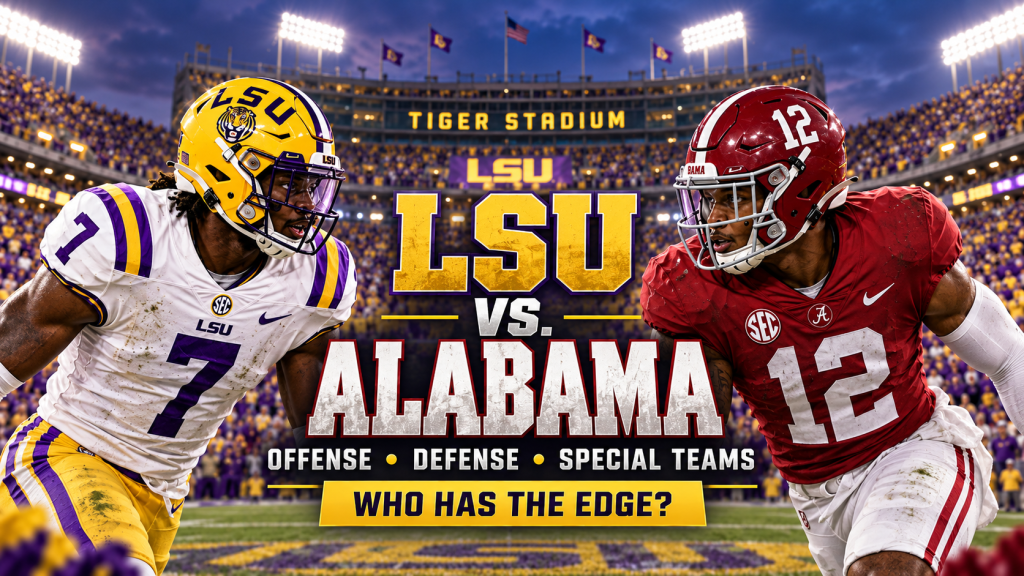
LSU and Alabama will renew their rivalry November 7 in Baton Rouge. A closer look at SEC rankings, individual players, and all three phases of the game gives Tiger fans plenty of reasons for optimism.
When Alabama arrives in Baton Rouge on November 7, the Crimson Tide will face an LSU team that has established itself as one of the SEC’s most balanced programs. Both teams enter their bye week with 6–2 records, but their statistics tell two very different stories.
LSU is producing more offense, surrendering fewer yards, and allowing fewer points. The Tigers are averaging 40.1 points per game while holding opponents to just 16.0. Alabama is scoring 38.3 per contest but allowing 21.3.
The numbers suggest LSU has an opportunity to control this game on both sides of the football. Add the advantage of playing in Tiger Stadium, and there is plenty of reason to believe the Tigers can send Alabama home with another loss.
Offense: LSU Has the Firepower to Exploit Alabama
LSU enters the matchup ranked second in the SEC in scoring offense, averaging 40.1 points per game. Alabama ranks fourth at 38.3. Although the scoring difference is relatively modest, LSU holds a considerably larger advantage in total offensive production.
The Tigers lead the conference with 500.5 yards per game. Alabama was averaging 416.6 yards and ranked eighth in the SEC in the most recently available comparable statistics before its October 24 contest.
That difference is significant. LSU has consistently demonstrated the ability to move the football, while Alabama has experienced stretches when its offense has struggled against quality competition.
Against Georgia, Alabama managed just 17 points. Tennessee held the Crimson Tide to 10. Although Alabama rebounded against Texas A&M, the inconsistency raises questions about how effectively its offense will perform against LSU’s defense.
Quarterback Sam Leavitt gives the Tigers a dynamic offensive weapon capable of beating defenses with both his arm and his legs. Against Auburn, Leavitt helped LSU generate 550 total yards, throwing three touchdown passes and adding a rushing touchdown in a convincing 38–17 victory.
Leavitt’s mobility could be particularly important against Alabama. When protection breaks down, he can escape pressure, extend plays, and punish defenses that lose containment.
Alabama quarterback Keelon Russell certainly possesses talent. His arm strength and ability to connect on deep passes make him dangerous, and he produced 1,614 passing yards and 13 touchdowns through his first five games. However, Russell will face a considerably different challenge against an LSU defense that has demonstrated the ability to disrupt quarterbacks.
In the backfield, LSU’s Dilin Jones gives the Tigers a productive rushing threat, while Harlem Berry adds speed and versatility. Together with Leavitt’s scrambling ability, they provide LSU with multiple ways to attack Alabama’s defense.
The receiving corps presents another potential advantage. Jackson Harris, Winston Watkins Jr., and Trey’Dez Green give Leavitt several dangerous targets. Green’s size creates difficult matchups, while Harris and Watkins can threaten Alabama’s secondary downfield.
Alabama counters with running backs Daniel Hill, Trae’shawn Brown, and EJ Crowell, along with receivers Ryan Coleman-Williams, Lotzeir Brooks, and Rico Scott. The Crimson Tide have playmakers, but LSU’s overall production suggests the Tigers have been better at turning their offensive talent into consistent results.
The advantage belongs to LSU. The Tigers have a more productive offense, a versatile quarterback, and enough weapons to challenge Alabama throughout the game.
Defense: The Tigers’ Biggest Advantage
If LSU’s offensive numbers are impressive, its defensive statistics are even more encouraging.
The Tigers lead the SEC in total defense, allowing just 258.1 yards per game. Alabama is surrendering 330.4 yards per contest, a difference of more than 72 yards.
LSU is also allowing only 16.0 points per game compared with Alabama’s 21.3.
The Tigers have been especially effective against the run, surrendering just 85.4 rushing yards per game. Alabama allows 108.0. LSU’s ability to shut down opposing ground attacks could force Russell into predictable passing situations.
The difference against the pass is just as notable. LSU is allowing only 172.8 passing yards per game, while Alabama is giving up 222.4.
Those statistics reflect the work defensive coordinator Blake Baker has done developing a unit capable of controlling the line of scrimmage, pressuring quarterbacks, and limiting explosive plays.
The Tigers’ performance against Auburn offered an excellent example. LSU held the Plainsmen to just 223 total yards and recorded seven sacks. Earlier, the Tigers shut out Mississippi State 31–0.
Those are the types of defensive performances that should concern Alabama.
Russell has already experienced difficulty when opposing defenses generate consistent pressure. LSU has the personnel and defensive scheme to make him uncomfortable, particularly on obvious passing downs.
Linebacker Whit Weeks remains one of the recognizable leaders of LSU’s defense, although his availability will need to be monitored as the matchup approaches. His instincts and tackling ability are valuable when healthy.
The biggest concern for LSU is Alabama’s ability to produce defensive touchdowns. The Crimson Tide have scored five times on defense through eight games, demonstrating an ability to turn opponent mistakes into immediate points.
That makes protecting the football particularly important for Leavitt and LSU’s running backs. Alabama’s defense might surrender more yards than LSU’s, but it can compensate by creating turnovers.
Still, the broader numbers strongly favor the Tigers.
The advantage belongs to LSU. The Tigers are allowing fewer points, fewer rushing yards, fewer passing yards, and significantly less total offense. If Baker’s defense maintains its current form, Alabama could struggle to sustain drives in Death Valley.
Special Teams: Alabama’s Best Opportunity
Special teams represent the one phase where Alabama holds a measurable advantage.
LSU kicker Scott Starzyk has converted nine of 11 field-goal attempts, an 81.8 percent success rate. Alabama kicker Conor Talty has connected on 11 of 13 attempts, good for 84.6 percent.
The difference is small, and both teams have received dependable production from their kicking games.
The larger separation comes in kickoff returns. In the available conference statistics, Alabama ranks third in the SEC with 25.44 yards per return, while LSU ranks ninth at 18.75.
That difference can influence field position, particularly in a tightly contested rivalry game.
Alabama’s return game gives the Crimson Tide an opportunity to begin possessions closer to midfield, potentially reducing the number of yards Russell and his offense must gain against LSU’s defense.
For LSU, the objective should be straightforward: cover kicks effectively, avoid unnecessary penalties, and prevent Alabama from creating explosive special-teams plays.
Starzyk’s reliability should give the Tigers confidence when drives stall in field-goal range. However, LSU cannot afford missed assignments or coverage breakdowns that provide Alabama with easy scoring opportunities.
The advantage belongs to Alabama, based on the available kicking and kickoff-return statistics. That edge is not overwhelming, and LSU can neutralize it with disciplined execution.
The Battle in the Trenches Could Decide Everything
One of the most revealing statistical differences between the programs involves quarterback protection.
Through eight games, LSU had allowed just 13 sacks, an average of 1.63 per contest. Alabama had surrendered 23, or 2.88 per game.
That is a substantial difference, especially considering the strength of LSU’s defensive front.
If the Tigers can pressure Russell without committing additional defenders to the pass rush, Alabama could find itself struggling to move the football consistently.
LSU’s offensive line has also demonstrated an ability to protect Leavitt while creating opportunities in the running game. That combination gives the Tigers greater flexibility in their play-calling.
The key will be winning first down. If Jones and Berry can establish a productive ground attack, Leavitt should find favorable passing situations against an Alabama defense allowing more than 220 passing yards per game.
Conversely, if LSU’s defense shuts down Alabama’s rushing attack, Russell could face a long afternoon trying to move the football against a defense that has been among the SEC’s best.
Death Valley Gives LSU Another Advantage
Statistics cannot fully measure what Alabama will encounter when it steps onto the field at Tiger Stadium.
Death Valley has earned its reputation as one of college football’s most intimidating environments. The noise, intensity, and emotion surrounding an LSU-Alabama showdown create challenges that visiting teams cannot fully reproduce during practice.
For a young quarterback like Russell, that environment could make communication and pre-snap adjustments especially difficult.
Alabama’s offensive line has already experienced protection problems. Crowd noise and the pressure generated by LSU’s defensive front could compound those issues.
The Tigers also have an opportunity to seize momentum early. A quick offensive touchdown followed by a defensive stop would put Alabama in the uncomfortable position of playing from behind in one of the SEC’s most hostile stadiums.
LSU fans understand how quickly the atmosphere can change when the Tigers make a big play against Alabama. One sack, one interception, or one explosive touchdown can turn an already loud stadium into an enormous advantage for the home team.
What LSU Must Do to Win
The formula for beating Alabama begins with taking care of the football.
The Crimson Tide have demonstrated an unusual ability to turn defensive takeaways into touchdowns. LSU must avoid giving Alabama easy points through interceptions, fumbles, or careless decisions.
Offensively, the Tigers should attack Alabama’s secondary while maintaining enough balance to prevent the Crimson Tide from concentrating exclusively on the passing game.
Leavitt’s mobility could become a major factor, particularly when Alabama brings pressure. His ability to turn a potential sack into a positive gain can frustrate defensive coordinators and extend possessions.
Defensively, LSU needs to establish control at the line of scrimmage. Alabama has struggled with pass protection, and the Tigers should take advantage by making Russell uncomfortable early and often.
Special teams must remain dependable. Alabama’s return-game advantage cannot be allowed to erase the field-position benefits created by LSU’s defense.
Most importantly, the Tigers need to play four complete quarters. Alabama possesses enough talent to make a comeback if LSU becomes careless or allows the Crimson Tide to generate explosive plays.
Final Analysis: LSU Has the Edge
Alabama remains Alabama. The Crimson Tide have talented players, capable coaches, and the ability to win difficult football games. Anyone expecting an easy victory simply because LSU holds the statistical advantage is underestimating the rivalry.
But there is no reason for LSU to enter this matchup intimidated.
The Tigers have the more productive offense, the stronger statistical defense, and the benefit of playing at home. They are moving the football more effectively, protecting their quarterback better, and limiting opposing offenses to significantly fewer yards.
Alabama’s advantages in defensive scoring and special teams deserve respect, but those strengths do not erase LSU’s superiority across many of the most important statistical categories.
The biggest question is whether the Tigers can turn those advantages into a complete performance.
If Leavitt protects the football, LSU establishes its running game, and Baker’s defense pressures Russell the way it pressured Auburn, the Tigers will have an excellent opportunity to control the contest.
Alabama is coming to Baton Rouge with the same 6–2 record as LSU. But based on the numbers through eight games, the Tigers have every reason to believe they are the better football team.
On November 7, they will have the opportunity to prove it.
And there is no better place to do that than Death Valley.

