
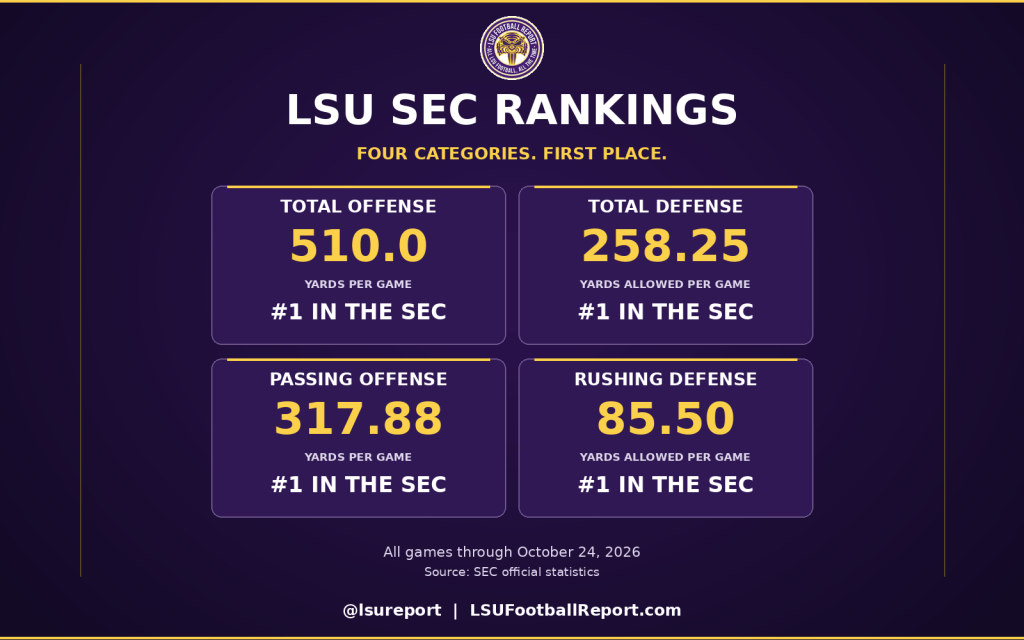
LSU is setting the SEC’s pace in two of football’s biggest statistical categories.
Through games played October 24, the Tigers rank first in the conference in both total offense and total defense. They also lead in passing offense and rushing defense, while several individual players sit near the top of the SEC leaderboards.
Those rankings cover all games played this season, including nonconference opponents. Following its victory at Auburn, LSU enters its open week with a statistical profile that shows how difficult this team can be to handle.
LSU’s Offense Sets the Conference Standard
Lane Kiffin’s offense has given opponents several problems to solve. LSU can move the ball through the air, sustain long possessions and convert when a drive reaches a critical down.
The Tigers’ strongest SEC offensive rankings include:
• No. 1 in total offense: 510.0 yards per game.
• No. 1 in passing offense: 317.88 yards per game.
• No. 1 in first downs: 28.0 per game.
• No. 1 in fourth down conversion percentage: 81.25 percent, converting 13 of 16 attempts.
• No. 2 in scoring offense: 40.13 points per game.
• No. 2 in third down conversion percentage: 51.69 percent, converting 61 of 118 attempts.
• No. 5 in rushing offense: 192.13 yards per game.
The combination matters. Opponents cannot simply sell out against LSU’s passing game when the Tigers also have one of the conference’s five most productive rushing attacks.
The conversion numbers are especially encouraging. LSU is extending possessions on more than half its third downs, then giving Kiffin another dependable option when he decides to keep the offense on the field.
Blake Baker’s Defense Leads the Way
LSU’s defensive success begins with making opponents work for their yardage.
Blake Baker’s group leads the SEC in total defense and rushing defense. The Tigers also rank among the conference’s best at limiting passing yards, preventing points and ending possessions.
LSU’s leading defensive rankings include:
• No. 1 in total defense: 258.25 yards allowed per game.
• No. 1 in rushing defense: 85.50 yards allowed per game.
• No. 2 in scoring defense: 16.0 points allowed per game.
• No. 2 in sacks: 34.
• No. 2 in third down defense: opponents have converted 30.70 percent of their attempts.
• No. 2 in fewest first downs allowed: 13.88 per game.
• No. 3 in passing defense: 172.75 yards allowed per game.
Stopping the run gives LSU a chance to dictate the next play. Opponents facing longer passing situations must contend with a pass rush that has consistently finished at the quarterback.
That is the strength of this defense. LSU can force an offense away from its preferred approach, then apply pressure when the passing situation becomes predictable.
Special Teams Provide Some Strong Numbers
LSU’s kickoff distance stands among the SEC’s best. The Tigers rank third in average kickoff distance at 64.40 yards, with 47 touchbacks on 57 kickoffs.
That ranking measures gross kickoff distance, rather than net coverage performance. Still, the touchbacks help LSU’s defense begin possessions without having to defend a return.
The Tigers have also converted all 40 extra point attempts. That is a perfect percentage and a share of first place in the conference.
Sam Leavitt Leads the SEC in Total Offense
Sam Leavitt’s ability to contribute through the air and on the ground has placed him atop the conference’s total offense leaderboard.
His strongest SEC rankings include:
• No. 1 in total offense: 312.0 yards per game.
• No. 1 in total passing yards: 2,172.
• No. 2 in passing yards per game: 271.50.
• Tied for No. 1 in touchdown passes: 17.
Leavitt has generated 2,496 yards of total offense, combining his passing production with 324 rushing yards.
Leading in total offense reflects the full challenge he presents. A defense that covers LSU’s receivers still has to account for what happens when Leavitt leaves the pocket.
Jackson Harris Leads in Touchdown Receptions
Jackson Harris has emerged as one of LSU’s most dangerous scoring threats.
His seven touchdown receptions lead the SEC. Harris has caught 36 passes for 634 yards, giving LSU a receiver who can turn a routine completion into a major gain.
His production gives the Tigers an explosive complement to their ability to sustain drives. LSU does not always need a long possession to reach the end zone.
Dilin Jones Ranks Among the SEC’s Best Backs
Dilin Jones ranks fifth in the conference in rushing yards per game at 82.25. He has rushed for 658 yards and six touchdowns.
Jones also ranks fifth in all purpose yards per game at 109.38. His 875 all purpose yards include 217 receiving yards.
That receiving contribution makes him particularly valuable. Jones can remain involved when LSU changes its approach, giving Leavitt another outlet without requiring the offense to substitute.
Princewill Umanmielen Anchors the Pass Rush
Princewill Umanmielen ranks second in the SEC in both sacks per game and tackles for loss per game.
He has recorded nine sacks and 12.5 tackles for loss, averaging 1.13 sacks and 1.56 tackles for loss per outing.
His disruption helps explain why LSU’s defensive rankings fit together so well. Negative plays create difficult downs, and difficult downs give Baker more opportunities to attack.
As LSU prepares for November, its strongest numbers point to a team capable of controlling games in several ways. The Tigers can produce explosive offense, sustain possessions, stop the run and pressure quarterbacks. Leading the SEC in both total offense and total defense puts real substance behind that confidence.
Sources
SEC official statistics portal and its linked conference team and individual leaderboards, updated through October 24. Rankings use season totals or per game averages as identified above.

