
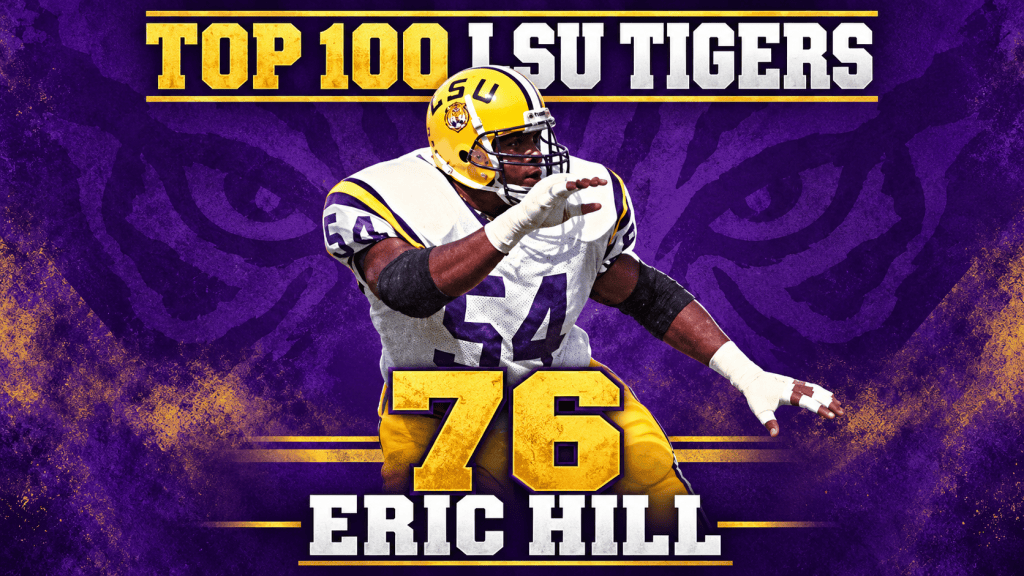
Some LSU defenders became famous for interceptions or spectacular sacks. Eric Hill built his reputation by overpowering blockers, punishing ball carriers and bringing an unmistakable physical presence to every game.
At 6 feet 2 inches and 245 pounds during his senior season, Hill possessed unusual size for an outside linebacker in the 1980s. He was powerful enough to battle offensive linemen and athletic enough to pursue runners across the field.
Hill became a three year starter, a permanent team captain, a first team All SEC selection and a leader on two SEC championship teams. His LSU career ultimately made him the 10th overall selection in the 1989 NFL Draft.
From Galveston to LSU
Eric Dwayne Hill was born in Blytheville, Arkansas, on November 14, 1966. His family moved to Galveston, Texas, when he was two years old.
Hill attended Ball High School, where he played defensive end and tight end. He also competed in basketball and track, including the high jump.
He earned all Houston and all district recognition on both sides of the football. During his senior season, Ball High advanced to the state semifinals.
Hill attracted recruiting interest from programs across the country. He considered schools including Oklahoma, Texas A&M, Notre Dame, UCLA and SMU.
He initially planned to attend Oklahoma. However, his high school coach, Ted Unbehagen, reminded him that he had promised LSU coach Bill Arnsparger he would visit Baton Rouge. Hill kept his word, visited LSU and eventually became a Tiger.
That decision gave LSU one of the most physically imposing linebackers of the decade.
Finding his position at LSU
Hill arrived at LSU in 1985 after playing primarily as a defensive end in high school. The Tigers moved him to outside linebacker, where his combination of size, speed and strength could affect more areas of the field.
Hill later explained that the change did not completely remove him from his original position.
“When I arrived at LSU I was moved to outside linebacker, but on third downs I basically played defensive end,” Hill told Da Boot Sports.
That role allowed Hill to become an early version of the versatile edge defenders seen throughout modern football. He could hold his ground against the run, pursue plays from the backside and move toward the line of scrimmage as a pass rusher.
As a freshman, Hill recorded 15 tackles while playing behind an experienced group of defenders. He moved into a starting role as a sophomore and remained an important part of the defense for the rest of his LSU career.
Verified LSU career statistics
LSU’s official season statistics credit Hill with the following regular season totals:
- 245 tackles
- 169 solo tackles
- 76 assisted tackles
- 10 quarterback sacks
- 5 forced fumbles
- 7 passes defended
Hill’s production increased as his role expanded.
After recording 15 tackles as a freshman, he finished with 49 tackles and 2 sacks in 1986. He followed that with 90 tackles and 5 sacks in 1987.
As a senior in 1988, Hill produced 91 tackles, 3 sacks, 5 tackles for loss, 2 forced fumbles, one fumble recovery and 3 passes defended.
Hill’s five career forced fumbles remained tied for fifth in LSU history in the school’s 2017 record book.
Four winning seasons in Baton Rouge
LSU enjoyed sustained success throughout Hill’s career.
The Tigers compiled 36 victories, 10 losses and 2 ties from 1985 through 1988. They reached a bowl game in all four seasons and finished in the Associated Press Top 20 three times.
LSU’s defense allowed only 10.3 points per game during the 1985 regular season, Hill’s freshman year. The Tigers finished with nine victories, two losses and one tie.
The 1986 team finished with nine victories and captured the SEC championship. LSU earned a trip to the Sugar Bowl, where it faced Nebraska.
Arnsparger departed after the season, and defensive coordinator Mike Archer became LSU’s head coach. The Tigers maintained much of their defensive system, which allowed Hill and the other returning players to continue developing within familiar roles.
LSU finished the 1987 season with 10 victories, one loss and one tie. The Tigers defeated South Carolina 30 to 13 in the Gator Bowl and finished fifth in the final Associated Press poll.
That remains one of the highest final rankings in LSU history outside its national championship seasons.
Captain of an SEC championship defense
Hill’s senior season cemented his place among LSU’s notable defensive leaders.
LSU selected Hill as one of its permanent team captains in 1988. He was joined by Tommy Hodson, Todd Coutee, Ralph Norwood and Greg Jackson.
The Tigers finished 6 and 1 in conference play and shared the SEC championship with Auburn. LSU earned the advantage on the field by defeating the fourth ranked Tigers 7 to 6 in one of the most famous games in Tiger Stadium history.
Auburn led 6 to 0 until Hodson found Eddie Fuller for a touchdown on fourth down late in the game. The reaction inside Tiger Stadium registered on a campus seismograph, giving the contest its lasting identity as the Earthquake Game.
Hill remembered the game for more than its dramatic finish.
“That was probably the most physical game I’ve ever played in,” Hill later told WWNO. “That was not for the weak.”
LSU’s defense also shut out 10th ranked Texas A&M, held Tennessee to 9 points and limited Mississippi State to 3. During the regular season, the Tigers held six opponents to fewer than 20 points.
Hill finished the season with a team leading 91 tackles. He earned first team All SEC recognition from the conference coaches and honorable mention All America recognition.
A top ten NFL draft pick
The Phoenix Cardinals selected Hill with the 10th overall choice in the 1989 NFL Draft.
At the time, Hill became LSU’s highest selected defensive player since the beginning of the common NFL Draft in 1967. He held that distinction until the Washington Redskins selected safety LaRon Landry with the sixth overall pick in 2007.
Hill was also LSU’s last first round linebacker for 30 years. The next was Devin White, whom Tampa Bay selected fifth overall in 2019.
Phoenix moved Hill from outside linebacker to the middle of its defense. The Cardinals believed his size, instincts and physical style made him an ideal professional middle linebacker.
Hill quickly justified their confidence.
He started 14 games during his rookie season and finished with 91 tackles and one sack. His performance earned him placement on several rookie teams, including the United Press International All Rookie team.
A long and productive NFL career
Hill played 11 seasons in the NFL.
He spent his first nine seasons with the Phoenix and Arizona Cardinals. He later played one season for the St. Louis Rams and finished his career with the San Diego Chargers in 1999.
Hill appeared in 160 regular season games and started 151. He started every game in four different seasons.
Pro Football Reference’s compiled records credit Hill with 1,043 career tackles, including 869 solo stops, along with 9 sacks. He also recorded 13 forced fumbles, four fumble recoveries and an interception.
His most productive documented season came in 1996, when he started all 16 games and led Arizona with 131 tackles. That total included 83 solo tackles and 48 assists.
Hill recorded at least 100 tackles in several seasons and became a dependable presence in the middle of the Cardinals defense. His value came from consistency, leadership and his willingness to handle the difficult work near the line of scrimmage.
The hard hitting outside linebacker LSU developed became a productive NFL middle linebacker who lasted more than a decade.
Why Eric Hill is No. 76
Eric Hill belongs among the Top 100 LSU Tigers of all time because he combined production, leadership, championships and professional success. He recorded 245 tackles and 10 sacks at LSU, led the 1988 Tigers with 91 tackles, earned first team All SEC honors and served as a permanent captain. He helped LSU win two SEC championships before becoming the 10th overall selection in the NFL Draft and starting 151 professional games. At No. 76, Hill represents the size, toughness and defensive tradition that have defined LSU football for generations.
Sources
- LSU Athletics, Eric Hill historical roster profile
- LSU Athletics, official football statistics archive
- LSU Athletics, permanent team captains and postseason awards
- LSU Football Media Guide, All SEC first team history
- Phoenix Cardinals 1990 Media Guide
- Pro Football Reference, Eric Hill career statistics
- Arizona Cardinals, 1996 defensive statistics
- WWNO, oral history of Tiger Stadium and the Earthquake Game

