
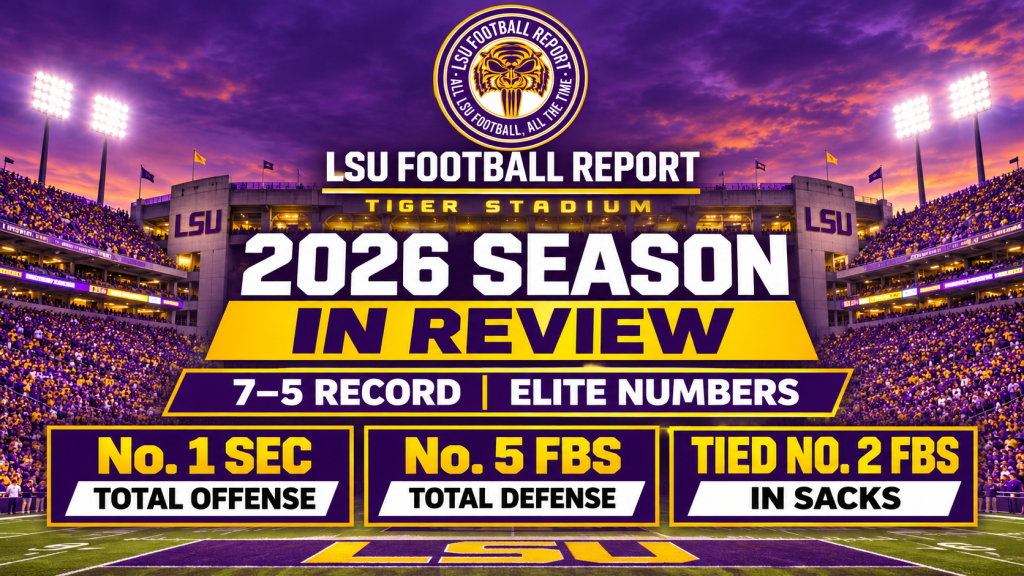
LSU’s 2026 regular season produced a remarkable statistical contradiction. The Tigers finished with seven victories and five defeats, yet led the Southeastern Conference in total offense, passing offense and first downs. Defensively, LSU finished among the nation’s best, ranking fifth in total defense and tied for second in sacks. Those are the kinds of numbers normally associated with championship contenders, not a team that finished in the middle of the SEC standings.
The season also produced exceptional individual performances. Quarterback Sam Leavitt led the SEC in total offense, running back Dilin Jones surpassed 1,000 rushing yards, Jackson Harris emerged as one of the conference’s most dangerous touchdown receivers, and Princewill Umanmielen anchored one of college football’s most productive pass rushes. LSU had the talent and production to compete with almost anyone. The problem was turning those advantages into victories when the games mattered most.
LSU’s Offense Was the SEC’s Most Productive
Whatever criticisms can be made about Lane Kiffin’s first season in Baton Rouge, his offense produced impressive numbers. LSU accumulated 5,721 total yards, averaging 476.8 yards per game. That production ranked first in the SEC and 10th nationally.
The passing game was especially productive. LSU finished with 3,638 passing yards, averaging 303.2 per contest. Both figures led the SEC, while the passing average placed the Tigers seventh nationally. LSU also led the conference with 314 first downs, a figure that ranked second in the FBS.
The Tigers scored 393 points, averaging 32.8 per game, and converted 48 percent of their third down opportunities. LSU also controlled the football for an average of 32 minutes and 34 seconds per contest.
Those statistics demonstrate that the offense was capable of moving the football against a variety of opponents. The Tigers were especially effective during the early portion of the season, scoring at least 35 points in four of their first five games.
But impressive yardage totals do not automatically produce championship seasons. LSU’s offensive production became much less reliable against the best defenses on its schedule, particularly when turnovers, protection breakdowns and missed scoring opportunities entered the equation.
Sam Leavitt: The SEC’s Total Offense Leader
Sam Leavitt delivered one of the most productive quarterback seasons in the conference, completing 292 of 413 passes for 3,250 yards and 21 touchdowns. His 70.7 percent completion percentage demonstrated the accuracy that made LSU’s passing game so effective throughout much of the year.
Leavitt was also an important part of the rushing attack, gaining 369 net rushing yards and scoring eight rushing touchdowns. Combined, he accounted for 3,619 yards of total offense, an average of 301.6 yards per game.
That production led the Southeastern Conference and ranked 11th nationally in individual total offense.
Leavitt announced his arrival with an outstanding performance against Clemson, passing for 230 yards and a touchdown while rushing for 113 yards and two scores. He was subsequently named SEC Offensive Player of the Week.
His ability to threaten defenses with both his arm and his legs provided LSU with flexibility that few quarterbacks could match. However, Leavitt also threw 12 interceptions, and turnovers became costly in several of LSU’s defeats.
The quarterback’s first season under Kiffin ultimately demonstrated both his tremendous potential and the importance of improving decision making and protection against elite competition.
Dilin Jones: LSU’s Most Complete Offensive Weapon
Few Tigers did more to help LSU’s offense than running back Dilin Jones. The sophomore finished with 1,072 rushing yards on 225 carries, averaging 4.8 yards per attempt and scoring 10 rushing touchdowns.
Jones was much more than a traditional running back. He also caught 46 passes for 288 yards, bringing his total production to 1,360 yards from scrimmage. Entering the Arkansas game, his 44 receptions ranked third nationally among running backs.
His versatility created matchup problems for opposing defenses. Jones could run between the tackles, attack the perimeter and provide Leavitt with a reliable receiving option when pressure disrupted the passing game.
Jones saved one of his best performances for the regular season finale against Arkansas. He rushed for 184 yards and two touchdowns, helping LSU produce more than 300 rushing yards and secure a 25–10 victory.
His performance against Arkansas was particularly significant after the Tigers had struggled to generate consistent rushing production during their three game losing streak.
If LSU is searching for a player who represents the offensive foundation moving forward, Jones belongs at the center of that conversation.
Jackson Harris Emerges as LSU’s Leading Receiver
Jackson Harris established himself as LSU’s most productive receiver, finishing with 61 receptions for 925 yards and nine touchdowns. He averaged 15.2 yards per reception, demonstrating his ability to generate significant gains rather than simply catching short passes.
His nine receiving touchdowns placed him among the SEC leaders and made him one of the conference’s most effective scoring threats.
Harris also provided one of the season’s more unusual statistical accomplishments, completing his only pass attempt for a 41 yard touchdown. His versatility illustrated the creative possibilities available within Kiffin’s offensive system.
Behind Harris, LSU received important contributions from Eugene Wilson III, Winston Watkins Jr. and Trey’Dez Green.
Wilson finished with 49 receptions for 511 yards, while Watkins added 41 catches for 517 yards and two touchdowns. The receiving depth helped LSU maintain one of the nation’s most productive passing offenses even as injuries and personnel changes affected the lineup.
Trey’Dez Green Continues Building His LSU Legacy
Trey’Dez Green remained one of college football’s most dangerous receiving tight ends when healthy. Despite appearing in only eight games, he finished with 47 receptions for 569 yards and four touchdowns.
Green averaged 71.1 receiving yards per appearance, an exceptional figure for a tight end. His ability to create mismatches against linebackers and defensive backs provided Leavitt with an important option throughout the season.
He also continued building on his place in LSU history as the school’s record setting touchdown producer at tight end.
Green’s availability was limited, but his production demonstrated the value of an athletic tight end in Kiffin’s offense. When LSU needed a receiver capable of creating difficult matchups, Green was often one of its most effective options.
His touchdown reception in the Arkansas finale provided another example of his importance in the passing game.
LSU’s Defense Was Among the Nation’s Best
While LSU’s offense generated enormous yardage totals, the defense quietly produced one of the most impressive statistical seasons in college football.
The Tigers allowed just 267.4 yards per game, ranking second in the SEC and fifth nationally. Opponents managed only 94.9 rushing yards per contest, placing LSU second in the conference and 10th in the FBS.
The passing defense was also outstanding, allowing 172.5 yards per game. That ranked third in the SEC and tied for 12th nationally.
LSU surrendered an average of only 18.2 points, and opposing offenses converted just 30 percent of their third down attempts. The defense also generated 44 sacks, tied for the second highest total in the nation.
Those numbers reflect a defense that consistently pressured quarterbacks, limited explosive plays and prevented opponents from establishing productive rushing attacks.
The defensive performances against Texas A&M and Mississippi State were particularly impressive. LSU held the Aggies to six points in a 35–6 victory and shut out Mississippi State 31–0, demonstrating its ability to control quality SEC opponents.
In many respects, LSU’s defense performed at a level worthy of championship consideration.
Princewill Umanmielen and the Tigers’ Relentless Pass Rush
Princewill Umanmielen was the centerpiece of LSU’s exceptional pass rush. The senior defensive end finished with 9.5 sacks, 14 tackles for loss and 10 quarterback hurries.
His sack total placed him among the SEC’s top pass rushers, while his consistent pressure helped LSU produce 44 sacks as a team.
Jordan Ross added six sacks and 11 tackles for loss, while Deuce Geralds contributed six sacks. Even safety Ty Benefield joined the pass rush, recording five sacks and demonstrating the versatility of LSU’s defensive personnel.
The pressure created by Umanmielen and his teammates was one of the most important elements of LSU’s defensive success. Opposing quarterbacks frequently had limited time to operate, while offensive coordinators were forced to account for pressure coming from multiple positions.
The Tigers’ 44 sacks ranked second in the SEC, trailing only Tennessee, and tied for second nationally with Baylor.
That production provided LSU with a defensive strength few programs could match.
LSU’s Defensive Standouts Deserve Recognition
Several other Tigers produced outstanding individual seasons on defense.
TJ Dottery led LSU with 88 tackles, providing consistency and leadership in the middle of the defense. Davhon Keys finished close behind with 84 tackles, nine tackles for loss and 3.5 sacks.
Ty Benefield emerged as one of the team’s most versatile defensive playmakers, recording 65 tackles, five sacks and a team leading three interceptions. His ability to contribute as a pass rusher and in coverage gave LSU an important weapon.
DJ Pickett demonstrated his potential as one of the nation’s most promising young defensive backs. He finished with two interceptions and a team leading 11 pass breakups, repeatedly challenging opposing receivers and creating opportunities for LSU’s defense.
Tamarcus Cooley contributed two interceptions, while PJ Woodland added an interception and 10 pass breakups.
Collectively, the Tigers intercepted 12 passes and consistently challenged opposing passing attacks. Their combination of pressure up front and talented defensive backs provided the foundation for LSU’s top five national defensive ranking.
The Victories That Showed LSU’s Potential
Several games demonstrated how dangerous LSU could be when all three phases of football contributed effectively.
The season began with a commanding 51–10 victory over Clemson. LSU generated 644 yards of total offense and established its offensive identity immediately. Leavitt, Jones and Jordan Ross earned SEC weekly recognition for their performances.
The 35–6 victory over No. 23 Texas A&M in September was another important statement. LSU’s defense overwhelmed the Aggies while the offense produced enough explosive plays to build a comfortable advantage.
October brought an even more impressive defensive performance when LSU shut out No. 16 Mississippi State 31–0. The Tigers followed that victory with a 38–17 win over Auburn, creating momentum heading into November.
The season finale against Arkansas provided another encouraging performance. Jones rushed for 184 yards, the defense prevented Arkansas from scoring an offensive touchdown, and LSU ended its three game losing streak with a 25–10 victory.
Those games demonstrated the team’s potential. When LSU protected the football, ran effectively and allowed its defense to control the opponent, the Tigers were extremely difficult to beat.
Unfortunately, those performances were not consistent enough to sustain a championship run.
Five Losses Defined by Missed Opportunities
The disappointment of LSU’s season cannot be explained by a lack of statistical production. The Tigers frequently moved the football and limited opposing offenses, but struggled in the situations that determined the outcomes of close games.
The 32–24 loss to Ole Miss in September was LSU’s first defeat. The Tigers followed with a heartbreaking 35–34 overtime loss at Kentucky in October, a game in which a 55 yard punt return touchdown helped the Wildcats overcome LSU.
November brought three consecutive defeats.
Alabama defeated LSU 31–13, exploiting offensive inconsistency and preventing the Tigers from converting enough scoring opportunities. Texas followed with a 22–21 victory after LSU surrendered an 11 point advantage, while Tennessee won 27–13 as protection problems and penalties disrupted the Tigers’ offense.
Across those three November losses, LSU scored only 47 combined points, an average of 15.7 per game. That was a dramatic decline from the 32.8 points the Tigers averaged over the entire regular season.
The contrast explains much of LSU’s disappointing record. The offense was statistically among the nation’s best, but the production declined sharply against several of the most difficult opponents on the schedule.
LSU’s defense repeatedly gave the team opportunities to win. Too often, turnovers, penalties, sacks and failures to finish drives prevented the offense from capitalizing.
Special Teams: The Biggest Statistical Weakness
One area where LSU struggled throughout the season was special teams, particularly punt coverage and field position.
The Tigers averaged just 34.0 net yards per punt, compared with 43.0 for their opponents. LSU also allowed 16 punt returns for 268 yards, an average of 16.8 yards per return, and surrendered two punt return touchdowns.
Those touchdowns were especially costly. Kentucky returned a punt 55 yards for a score in a one point LSU defeat, while Arkansas returned another punt 79 yards for a touchdown in the regular season finale.
The kicking game produced mixed results. Scott Starzyk converted 15 of 20 field goal attempts, including a season long 52 yard field goal against Arkansas, while making 46 of 48 extra point attempts.
Starzyk also delivered an important contribution on kickoffs, recording 63 touchbacks on 74 attempts.
Nevertheless, missed kicks and poor punt coverage contributed to LSU’s inability to maximize its offensive and defensive advantages.
The difference between LSU’s impressive yardage statistics and its actual record reinforces an important reality: special teams can erase advantages created elsewhere.
The Fourth Quarter Tells Its Own Story
One of the most revealing statistics from the 2026 season involves LSU’s production by quarter.
The Tigers outscored opponents 105–33 in the first quarter and 122–30 in the third. Those numbers demonstrate that LSU was often well prepared to begin games and capable of making effective halftime adjustments.
But the fourth quarter told a different story.
LSU scored just 65 fourth quarter points while allowing 72. The Tigers’ inability to maintain offensive production late in games became particularly damaging against Texas and Tennessee.
The Texas defeat was especially painful because LSU entered the fourth quarter with an opportunity to protect its lead. Against Tennessee, the Tigers were tied entering the final period before surrendering two touchdowns.
Those performances highlight an area requiring immediate improvement. Championship teams must be capable of closing games, sustaining drives and protecting leads when opponents make their final adjustments.
LSU consistently demonstrated the ability to establish control. The next challenge is learning how to maintain it.
What LSU Must Improve Before 2027
Kiffin’s first regular season produced undeniable statistical accomplishments, but the final record makes clear that substantial improvement is necessary.
Offensive line consistency must be a priority. LSU cannot continue allowing protection breakdowns that disrupt Leavitt and eliminate opportunities for explosive plays. The rushing attack must also become more dependable against the league’s strongest defensive fronts.
Red zone execution remains another concern. LSU converted 51 of 62 red zone trips into points, but scored touchdowns on only 39 of those possessions. For an offense that moved the football as effectively as LSU, too many opportunities ended without maximum points.
The Tigers must also improve late game execution, reduce costly turnovers and address the special teams problems that repeatedly affected field position.
Defensively, LSU has an excellent foundation. The challenge will be replacing departing contributors while maintaining the pressure and coverage production that made the 2026 defense one of the nation’s best.
The encouraging news is that the program has evidence of what works. LSU does not need to invent an offensive identity or completely rebuild its defensive philosophy. The foundation is already visible in the statistics.
What must improve is consistency.
Final Assessment: Better Than the Record, but Not Good Enough
LSU finished the 2026 regular season with a 7–5 record, a disappointing result for a program that entered the year expecting to compete for championships.
But the statistical accomplishments deserve recognition.
The Tigers led the SEC in total offense, passing offense and first downs. They finished among the nation’s top 10 in total offense, passing offense, total defense, rushing defense and sacks, with their first down production ranking second nationally.
Leavitt led the SEC in total offense. Jones surpassed 1,000 rushing yards and contributed more than 1,300 yards from scrimmage. Harris emerged as one of the league’s most dangerous scoring receivers, while Green continued building an impressive LSU legacy.
Defensively, Umanmielen anchored an outstanding pass rush, Dottery and Keys delivered consistent tackling production, and Benefield, Pickett and the secondary helped LSU establish one of the nation’s stingiest defenses.
Those accomplishments should not be overshadowed by the team’s record.
At the same time, the five losses cannot simply be dismissed as bad luck. LSU repeatedly failed to convert statistical advantages into victories, particularly against ranked opponents and during critical fourth quarter situations.
The 2026 Tigers were talented enough to produce championship caliber statistics. They were not consistent enough to produce a championship caliber record.
That is both the disappointment of the season and the opportunity ahead.
LSU has already demonstrated that it can compete statistically with the best teams in college football. The challenge for 2027 is making sure those numbers translate into wins when they matter most.
Sources
- LSU Athletics: Official 2026 Season Team and Individual Statistics
- LSU Athletics: Complete 2026 Schedule, Results and Game Box Scores
- CFBStats: 2026 SEC Total Offense Leaders
- CFBStats: 2026 National Total Offense Leaders
- CFBStats: 2026 National Passing Offense Leaders
- CFBStats: 2026 National First Downs Leaders
- CFBStats: 2026 National Total Defense Leaders
- CFBStats: 2026 National Rushing Defense Leaders
- CFBStats: 2026 National Passing Defense Leaders
- CFBStats: 2026 National Team Sack Leaders
- CFBStats: 2026 SEC Individual Total Offense Leaders
- CFBStats: 2026 National Individual Total Offense Leaders
- CFBStats: 2026 SEC Individual Sack Leaders
- LSU Athletics: Three Tigers Earn SEC Honors After Clemson Victory
- On3: LSU Pregame Notes and Individual Achievements Entering Arkansas

