
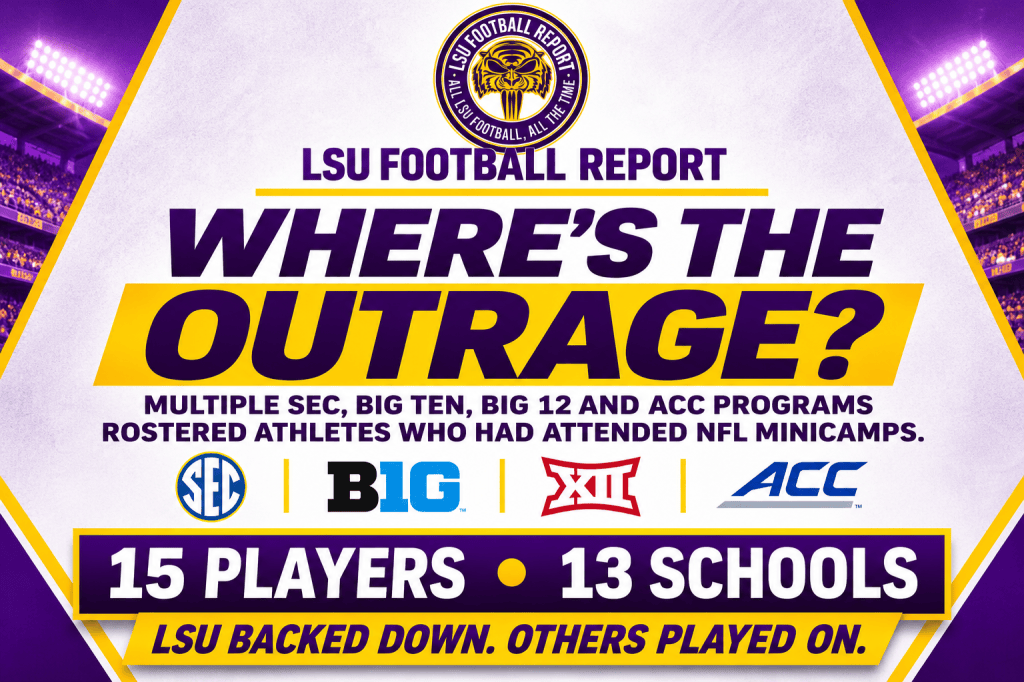
LSU found itself at the center of a national controversy when Lane Kiffin attempted to bring two former NFL players back to college football. The Southeastern Conference threatened severe consequences, legal battles erupted, and the Tigers ultimately backed down. Dae’Quan Wright and Zxavian Harris were left off LSU’s roster despite court rulings that had opened the door for their return. But while LSU absorbed much of the criticism, other major college football programs were quietly adding players who had already pursued opportunities in the NFL.
Where was the outrage when Arkansas, Missouri, Oklahoma, Kentucky, South Carolina, Texas, Arizona, Houston, Texas Tech, Minnesota, UCLA and Virginia Tech rostered players who had participated in NFL tryouts or rookie minicamps? A review of the 2026 season identifies 15 athletes across 13 college programs, including New Mexico, who returned to college football rosters after documented NFL opportunities. Fourteen of those players were associated with 12 programs in the SEC, Big Ten, Big 12 and ACC. Most had not signed NFL contracts, an important distinction under conference eligibility rules, but every case raises questions about how college football’s changing eligibility standards are being applied and explained.
The List: 15 Players, 13 College Football Programs
The following players attended NFL rookie minicamps, participated in NFL tryouts or had documented NFL team involvement before returning to college football rosters in 2026.
SEC — 6 Schools, 7 Players
- Arkansas
- Brylan Green, DB — Kansas City Chiefs and Minnesota Vikings rookie minicamps.
- Sean Williams, DB — Tennessee Titans rookie minicamp.
- Missouri
- Sterling Webb, DT — Buffalo Bills rookie minicamp.
- Oklahoma
- Braxton Fely, DT — Denver Broncos rookie minicamp.
- South Carolina
- Ethan Sanchez, K — San Francisco 49ers rookie minicamp.
- Texas
- Cole Hutson, OL — Cleveland Browns and Dallas Cowboys rookie minicamps.
- Kentucky
- Alex Afari Jr., LB — Green Bay Packers rookie minicamp. Played four games before subsequent eligibility litigation.
Big Ten — 2 Schools, 2 Players
- UCLA
- Trent Hendrick, LB — Kansas City Chiefs and Cleveland Browns rookie minicamps.
- Minnesota
- Luke Drzewiecki, K — Baltimore Ravens rookie minicamp, with transaction records reporting a signing and subsequent release.
Big 12 — 3 Schools, 4 Players
- Arizona
- Max Harris, LB — Denver Broncos rookie minicamp.
- Houston
- Stephon “Boogie” Johnson, WR — New York Giants rookie minicamp.
- Myles Rowser, S — Seattle Seahawks rookie minicamp.
- Texas Tech
- Tommy Castellanos, QB — Miami Dolphins rookie minicamp, where he tried out as a wide receiver.
ACC — 1 School, 1 Player
- Virginia Tech
- DQ Smith, S — Minnesota Vikings tryout following NFL minicamp invitations.
Mountain West — 1 School, 1 Player
- New Mexico
- Jayden Flaker, LB — Buffalo Bills rookie minicamp.
Total: 15 documented players across 13 schools in five conferences.
These are documented 2026 roster cases, not a claim that all 15 were active throughout the season or signed standard NFL player contracts. Most participated only in tryouts or minicamps, and some encountered subsequent eligibility disputes. The distinction is important, but the number of programs involved is impossible to ignore.
LSU Faced a Threat Few Programs Have Ever Experienced
When LSU pursued tight end Dae’Quan Wright and defensive lineman Zxavian Harris, the response from the SEC was swift and extraordinary. Both players had entered the NFL after exhausting their original college eligibility, signed professional contracts and subsequently pursued the opportunity to return following changes to NCAA eligibility rules and favorable court decisions.
Rather than quietly allowing the matter to proceed through the courts, the SEC adopted restrictions on professional athletes returning to conference competition. The league also initiated litigation involving LSU and Kiffin, escalating a dispute over two players into a confrontation between one of college football’s most powerful conferences and one of its most prominent member institutions.
LSU ultimately decided not to put Wright and Harris on its official roster. The Tigers complied despite the legal uncertainty surrounding the players’ eligibility, surrendering the opportunity to use two experienced contributors who might have strengthened the team.
The controversy has not disappeared. Reuters reported November 24 that the SEC was considering LSU’s membership status at a December 3 meeting. The possibility of terminating a founding member’s conference membership demonstrates just how serious this confrontation has become.
Yet LSU was hardly the only major program exploring college football’s rapidly changing eligibility landscape.
Six SEC Programs, Seven Players and One Very Interesting Double Standard
Start with the SEC itself. During the 2026 season, six conference programs rostered a combined seven players who had previously attended NFL rookie minicamps or tryouts.
Arkansas added two defensive backs with NFL experience at the tryout level. Brylan Green, formerly of Liberty, participated in rookie minicamps with the Kansas City Chiefs and Minnesota Vikings before joining the Razorbacks. Sean Williams, a former Dartmouth defensive back, attended a Tennessee Titans rookie minicamp before transferring to Arkansas.
Both players appeared on Arkansas’ 2026 roster, and Green recorded game participation. Arkansas was apparently comfortable bringing in players who had already pursued opportunities with professional organizations.
Missouri welcomed defensive tackle Sterling Webb back after he participated in the Buffalo Bills’ rookie minicamp. Webb even became involved in litigation over his eligibility as the SEC’s new restrictions created uncertainty about his status. Despite that controversy, Missouri worked to keep him in its defensive line rotation.
Oklahoma added former Boise State defensive tackle Braxton Fely after he attended a Denver Broncos rookie minicamp. Fely obtained court protection allowing him to compete during the 2026 season, and the Sooners added him to their defensive line despite the broader eligibility controversy.
South Carolina added former Houston kicker Ethan Sanchez shortly before the season. Sanchez had participated in the San Francisco 49ers’ rookie minicamp but had not signed an NFL contract. Coach Shane Beamer publicly explained that distinction when discussing the addition.
Texas brought back offensive lineman Cole Hutson after NFL tryouts with the Dallas Cowboys and Cleveland Browns. Hutson initially encountered eligibility difficulties but was eventually cleared to return to the Longhorns. His case demonstrated that even one of the SEC’s most prominent programs was willing to pursue additional eligibility for a player who had already tested the NFL market.
Kentucky also brought back linebacker Alex Afari Jr. after he attended a Green Bay Packers rookie minicamp. Afari appeared in four games before his eligibility became the subject of additional court action. He subsequently received further legal relief, illustrating how complicated these cases have become.
That is seven players associated with six SEC programs, all of whom had pursued NFL opportunities before returning to college rosters.
To be clear, these are not seven identical cases of signed NFL professionals returning to the SEC. The distinction between participating in a minicamp and signing an NFL player contract matters under the conference’s rules. Nevertheless, the extent of these returns makes it difficult to portray LSU as the only program attempting to navigate the new eligibility environment.
If the purpose of the SEC’s restrictions is to establish a clear boundary between professional football and college football, fans deserve a consistent explanation of exactly where that boundary begins.
The Big Ten Was Doing It Too
The SEC was not alone in confronting this issue. Two Big Ten programs added players who had participated in NFL rookie minicamps before returning to college football.
UCLA added linebacker Trent Hendrick after the former James Madison standout participated in rookie minicamps with the Cleveland Browns and Kansas City Chiefs. Hendrick did not sign an NFL contract, making him eligible under the Big Ten’s interpretation of its restrictions.
Hendrick joined UCLA after receiving court protection related to the NCAA’s eligibility changes. The Bruins made it clear they believed the addition complied with conference policy.
Minnesota added former New Mexico kicker Luke Drzewiecki following his participation in a Baltimore Ravens rookie minicamp. Drzewiecki returned to college football and played for the Golden Gophers, later making important contributions during the season.
Drzewiecki’s professional status has been described differently by various sources. Some NFL transaction listings record a signing and waiver, while reporting surrounding Minnesota’s eligibility decision describes his minicamp participation as unsigned. That discrepancy deserves clarification rather than an assumption that his circumstances were identical to LSU’s.
The important point is that both Minnesota and UCLA used the available eligibility process to add players who had already pursued professional football opportunities.
Neither situation produced the same sustained national confrontation that surrounded LSU.
The Big 12 Had Four Players Across Three Programs
The Big 12 provides another compelling example of college football’s changing eligibility environment.
Arizona brought back linebacker Max Harris after he participated in the Denver Broncos’ rookie minicamp. Harris was among the players added to Arizona’s roster following court rulings involving an additional season of eligibility.
Houston added two players with NFL minicamp experience. Wide receiver Stephon “Boogie” Johnson returned after attending the New York Giants’ rookie minicamp, while defensive back Myles Rowser joined the Cougars after participating in Seattle Seahawks rookie camp activities.
Johnson received court protection supporting his return, while Rowser joined Houston after pursuing an NFL opportunity following his career at Arizona State. Both were part of Houston’s 2026 football program.
Texas Tech added quarterback Tommy Castellanos after the former Florida State starter attended a Miami Dolphins rookie minicamp, where he tried out as a receiver. Castellanos returned to college football and joined the Red Raiders despite having previously declared for the NFL Draft.
The Big 12 distinguished between players who signed professional contracts and those who participated only in tryouts. That interpretation allowed Castellanos to join Texas Tech without being classified as a returning professional player under the conference’s restrictions.
Four players. Three Big 12 programs. All with documented NFL minicamp experience before joining college football rosters.
These cases demonstrate how widespread the pursuit of additional eligibility became once players and universities realized the new NCAA framework could provide another season of competition.
The ACC Was Not Immune
Virginia Tech added former South Carolina safety DQ Smith after he pursued several professional opportunities. Smith received NFL minicamp invitations and later participated in tryout activity with the Minnesota Vikings before returning to college football.
Virginia Tech added Smith to its 2026 roster, and coach James Franklin publicly discussed the process of evaluating his eligibility. The Hokies considered both the legal situation and the player’s professional background before proceeding.
Smith’s return provides another example of a Power Four program adding a player who had already attempted to begin an NFL career.
His situation also reinforces why the terminology matters. Attending a tryout does not automatically mean the player signed a contract, occupied a regular NFL roster spot or became ineligible for college competition.
But it does mean Virginia Tech, like several other major programs, benefited from the changing eligibility rules after a player had explored professional opportunities.
Even Outside the Power Four, the Practice Continued
The issue extended beyond the four largest conferences.
New Mexico added former Memphis linebacker Jayden Flaker after he participated in the Buffalo Bills’ rookie minicamp. Flaker joined the Lobos during August, with coach Jason Eck publicly acknowledging the player’s NFL minicamp experience.
Flaker’s addition brings the documented total to 15 athletes across 13 college programs.
That figure is significant because it demonstrates that former NFL minicamp participants returning to college football was not an isolated occurrence limited to LSU or one conference. It happened across multiple regions, competitive levels and eligibility proceedings.
The actual number could be higher. There is no single comprehensive public database identifying every 2026 college football player who previously participated in an NFL tryout. The 15 cases identified here represent documented examples, not a certified nationwide maximum.
The Difference Between an NFL Contract and an NFL Tryout
There is one legitimate counterargument to LSU’s case, and it deserves to be acknowledged.
Wright and Harris signed NFL contracts. Most of the players identified at other schools participated only in rookie minicamps or tryouts without signing standard NFL player contracts. Under the restrictions adopted by several conferences, that distinction determines whether a player is prohibited from returning.
It would therefore be inaccurate to suggest that every one of these schools violated the same rule LSU was accused of challenging.
But that legal distinction should not end the discussion.
The broader controversy began because college football changed its eligibility rules after some athletes had already exhausted their opportunities, declared for the NFL Draft or participated in professional evaluations. Courts subsequently ruled in favor of various players seeking an additional year, forcing conferences and universities to interpret new rules under difficult circumstances.
Across the country, schools responded by seeking competitive advantages wherever the rules permitted them. Texas, Arkansas, Oklahoma, Missouri, Kentucky, South Carolina, UCLA, Minnesota, Arizona, Houston, Texas Tech and Virginia Tech were all willing to add players with prior NFL involvement at the tryout level.
LSU pursued the same general opportunity, but its two prominent additions involved signed NFL contracts and therefore triggered more severe consequences.
The question is not whether the legal circumstances were identical. They were not.
The question is why the national conversation so often portrayed LSU as the symbol of everything wrong with college football while giving relatively little attention to how extensively other programs were benefiting from the same changing eligibility environment.
LSU Backed Down While Others Took Advantage
LSU ultimately chose not to roster Wright and Harris. Whether that decision was prudent, disappointing or unavoidable depends on how one weighs the legal risks, conference relationships and potential penalties.
What is undeniable is that other schools continued adding players who had already pursued NFL opportunities, provided they could establish eligibility under the applicable rules.
LSU lost the opportunity to strengthen its roster with two players it wanted. Other programs received additional experienced players through court rulings, minicamp exceptions and new eligibility interpretations.
This disparity in outcomes does not automatically demonstrate unequal enforcement. Different circumstances can justify different legal decisions. But it does demonstrate why the entire situation deserves much greater transparency.
The NCAA and the conferences should clearly explain which professional activities end college eligibility, which do not, and why. Those standards should be applied consistently to every school, regardless of conference affiliation, reputation or competitive significance.
Most importantly, those standards should be established before athletes make career decisions, not after they have already entered the NFL Draft, attended professional workouts or signed contracts.
Where’s the Outrage?
Fifteen documented players. Thirteen college programs. Six SEC schools, three Big 12 programs, two Big Ten programs, one ACC school and one Mountain West program.
That is not a handful of isolated rumors. It is a documented pattern of college football programs adding athletes who had previously pursued NFL opportunities.
Yet the loudest controversy centered on LSU.
The Tigers were criticized for attempting to take advantage of an uncertain eligibility system, while numerous other programs found ways to bring former NFL minicamp participants back to their rosters. In some cases, those players received immediate opportunities to contribute during the 2026 season.
The signed contract distinction explains much of the legal difference, but it does not explain why the public discussion has focused so heavily on one school while largely overlooking the broader trend.
LSU did not invent this controversy. LSU did not create the changing NCAA eligibility rules. And LSU was far from the only school looking for experienced players who thought their college careers had ended.
The Tigers ultimately backed down. Other programs moved forward under rules that permitted their additions.
If college football wants to debate the wisdom of allowing players to return after pursuing NFL opportunities, then debate the entire practice. Examine every school. Apply transparent standards. And stop pretending LSU was the only program testing the boundaries of college eligibility.
Sources
- Reuters: SEC to Weigh Terminating LSU as Member at December 3 Meeting
- CBS Sports: LSU Leaves Former NFL Players Off Final Roster
- Associated Press: Big Ten and SEC Restrictions on Former NFL Players
- Arkansas Athletics: Brylan Green Player Biography
- Arkansas Athletics: Sean Williams Player Biography
- On3: Missouri Defensive Lineman Sterling Webb Eligibility Case
- Sports Illustrated: Braxton Fely Cleared to Join Oklahoma
- ABC Columbia: South Carolina Adds Kicker Ethan Sanchez
- Sports Illustrated: Texas OL Cole Hutson Eligibility Decision
- Kentucky Athletics: 2026 Player Biographies and Alex Afari Jr.
- Los Angeles Times: Trent Hendrick Commits to UCLA
- Minnesota Star Tribune: Minnesota Adds Luke Drzewiecki
- CBS Sports: Arizona Adds Players Including Max Harris
- Houston Chronicle: Stephon Johnson Receives Additional Eligibility
- Houston Chronicle: Myles Rowser Joins Houston After Seahawks Minicamp
- NBC Sports: Tommy Castellanos Returns to College Football at Texas Tech
- Virginia Tech: 2026 Football Roster and DQ Smith
- Albuquerque Journal: Jayden Flaker Joins New Mexico After Bills Minicamp

