
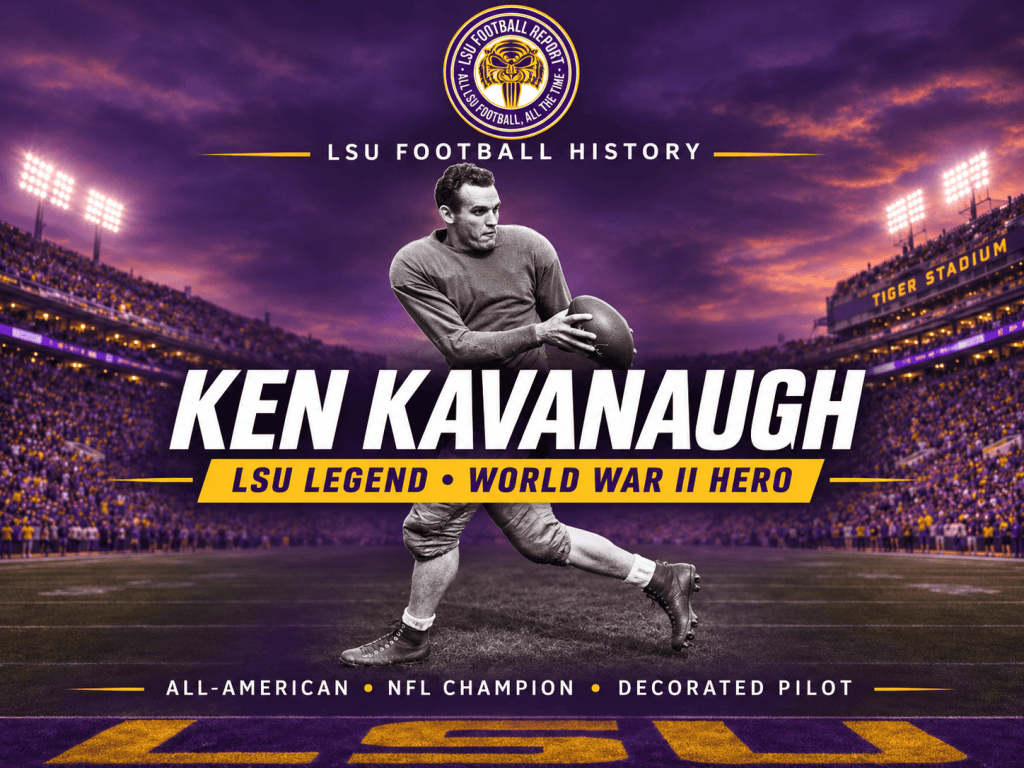
Before Joe Burrow, Billy Cannon and the modern stars of LSU football, there was Ken Kavanaugh. One of the greatest receivers in Tigers history, Kavanaugh was an All-American, an NFL champion and eventually a College Football Hall of Famer. But his most extraordinary accomplishments did not come on a football field. They came thousands of feet above Nazi Germany, where the former LSU star served as a decorated American bomber pilot during World War II.
Born November 23, 1916, Kavanaugh would have celebrated his 110th birthday today. His remarkable life deserves recognition not simply because of his contributions to LSU football, but because he answered his country’s call during one of history’s darkest periods. He traded his Chicago Bears uniform for the uniform of the United States Army Air Forces, flew 30 combat missions over enemy territory and returned home with some of military aviation’s most respected decorations.
An LSU Football Legend Before the War
Kenneth William Kavanaugh arrived at LSU from Little Rock, Arkansas, and quickly developed into one of the most talented athletes in school history. Standing 6 feet 3 inches tall, he possessed exceptional speed, athleticism and an ability to catch passes that was extraordinary for an era when college football offenses relied heavily on running the ball.
Playing for coach Bernie Moore from 1937 through 1939, Kavanaugh earned first team All-SEC honors in both 1938 and 1939. During his senior season, he led the nation with 30 receptions for 467 yards, establishing himself as one of college football’s most dangerous offensive weapons.
His 1939 accomplishments included consensus All-America recognition, the SEC Co-Most Valuable Player award and the Knute Rockne Memorial Award, becoming the first lineman to receive that distinction. Kavanaugh also finished seventh in the Heisman Trophy voting, a remarkable achievement for a player whose position rarely received consideration for the award.
Perhaps his most memorable LSU performance came against Holy Cross on October 7, 1939. Kavanaugh scored all four LSU touchdowns in an upset victory, catching three scoring passes from Leo Bird and adding another touchdown on a defensive return. It was the kind of performance that established his place among the legends of LSU football.
Two years earlier, he had produced another unforgettable moment against Rice, recovering a fumble and returning it 100 yards for a touchdown. Kavanaugh could change a game as a receiver, defender or with his extraordinary athletic ability.
Interestingly, the trip to Holy Cross also provided an unusual glimpse into Kavanaugh’s future. LSU traveled to the game by airplane, an uncommon practice for college football teams at the time. According to the Louisiana Sports Hall of Fame, Kavanaugh became airsick during the journey.
Only a few years later, the young man who had struggled through a football team’s airplane trip would be piloting American bombers into combat over Europe.
From the Chicago Bears to the United States Army Air Forces
Following his LSU career, Kavanaugh entered professional football when the Chicago Bears selected him in the second round of the 1940 NFL Draft. He quickly became an important part of George Halas’ powerful Chicago teams, helping the Bears win NFL championships in 1940 and 1941.
Kavanaugh’s professional career was taking off when the Japanese attack on Pearl Harbor brought the United States into World War II. Like many American athletes of his generation, he faced a decision about continuing his career or serving his country.
Kavanaugh chose military service.
He entered the Army Air Forces in 1942, interrupting his professional football career for approximately three years. He completed military aviation training and eventually served as a bomber pilot in the European Theater of Operations.
According to the Encyclopedia of Arkansas, Kavanaugh served with the Eighth Air Force, 490th Bombardment Group, 851st Bombardment Squadron. He attained the rank of captain and flew 30 combat missions over Germany.
Those missions placed him in one of the most dangerous assignments undertaken by American aircrews during the war.
Thirty Combat Missions Over Nazi Germany
During World War II, the Eighth Air Force conducted a massive strategic bombing campaign against Nazi Germany. American bomber crews attacked military factories, transportation networks, oil production facilities, airfields and other targets supporting the German war effort.
Kavanaugh’s 490th Bombardment Group initially operated B-24 Liberator heavy bombers before converting to the B-17 Flying Fortress. Based at RAF Eye in England, the group participated in operations across occupied Europe and Germany.
According to the Army Air Corps Library and Museum, the 490th attacked German military industry and transportation infrastructure, including targets in Berlin, Hamburg, Hannover, Cologne and other major cities. The group also supported Allied ground operations during the Battle of the Bulge in December 1944 and January 1945.
These were dangerous missions conducted under the threat of German fighter aircraft, antiaircraft artillery, mechanical failures and the unpredictable conditions of high altitude combat.
Every successful mission required extraordinary cooperation among pilots, navigators, bombardiers, gunners and other crew members. A bomber pilot carried responsibility not only for the aircraft and its mission, but also for the lives of the men serving alongside him.
Kavanaugh completed 30 combat missions over Germany during his wartime service. His actions earned him the Distinguished Flying Cross and the Air Medal with four Oak Leaf Clusters.
The Distinguished Flying Cross recognizes heroism or extraordinary achievement while participating in aerial flight. The Air Medal recognizes meritorious achievement or service in aerial operations, while Oak Leaf Clusters denote additional awards.
These decorations represent a level of military accomplishment that far exceeds any football trophy.
Kavanaugh had already proven himself under pressure on the playing field. In wartime, he demonstrated courage and professional skill in circumstances where the consequences were far greater than winning or losing a game.
A Decorated Veteran Returns to Football
When World War II ended, Kavanaugh returned to the Chicago Bears in 1945 and resumed his football career. Despite spending three years away from professional competition, he quickly reestablished himself as one of the NFL’s most dangerous receivers.
He helped Chicago capture another NFL championship in 1946 and continued producing remarkable receiving performances. During the 1947 season, Kavanaugh caught 32 passes for 818 yards and 13 touchdowns, averaging an extraordinary 25.6 yards per reception.
Over eight NFL seasons, he recorded 162 receptions for 3,626 yards and 50 receiving touchdowns. His career average of 22.4 yards per reception reflected his exceptional ability to stretch defenses long before the modern passing game became the dominant force in professional football.
Kavanaugh was also selected to the NFL’s 1940s All-Decade Team, recognition of his impact during an era when professional football was still developing into the sport Americans know today.
His accomplishments were especially remarkable considering the interruption caused by his military service. Three of his prime athletic years were spent serving his country rather than accumulating NFL statistics.
Yet Kavanaugh returned from war and continued performing at an elite level.
A Lifetime Devoted to Football and Service
Kavanaugh’s influence on professional football extended long after his playing career ended in 1950. Following coaching assignments with Chicago and at the college level, he joined the New York Giants in 1955.
He served as a Giants assistant coach through 1970 before moving into scouting, where he remained until retiring in 1999. His 45 years with the organization demonstrated the same commitment and dependability that characterized his athletic and military careers.
In 1963, Kavanaugh was inducted into the College Football Hall of Fame, formally recognizing his extraordinary accomplishments at LSU.
His family also worked to preserve his story. His son, Ken Kavanaugh Jr., wrote The Humility of Greatness: The Adventures of a WWII Hero and NFL Legend, a biography honoring his father’s remarkable life both on and off the football field.
Kavanaugh died on January 25, 2007, at age 90, leaving behind a legacy that spanned college football, professional championships, military service and decades of mentoring future generations of players.
Even his football trading cards acknowledged his wartime achievements. A 1950 Bowman football card, now preserved in the Metropolitan Museum of Art’s collection, noted his Army Air Forces service and recognition for bravery.
It is a small but meaningful reminder that Americans of his generation understood Kavanaugh was more than a football star.
Remembering an LSU Tiger Who Served His Country
LSU has produced countless outstanding football players, including Heisman Trophy winners, national champions, NFL legends and members of the College Football Hall of Fame. But Kavanaugh belongs to a special generation of athletes whose lives were interrupted by a world war.
He played football when Tiger Stadium was still developing its legendary reputation, professional football was in its early years and American athletes were beginning to emerge as national celebrities. Then, when his country needed him, Kavanaugh set aside his professional ambitions and entered military service.
His story is also connected to LSU’s broader military heritage. Long before the university became internationally recognized for its athletic programs, LSU maintained strong military traditions and produced generations of officers and Service Members who answered the nation’s call.
Kavanaugh embodied both traditions. He was a celebrated athlete who represented LSU with distinction, and an American airman who accepted the dangers of combat service during World War II.
On what would have been his 110th birthday, remembering Kavanaugh provides an opportunity to recognize accomplishments that deserve to be celebrated alongside the greatest moments in LSU football history.
The Bottom Line: A Tiger on the Field, a Hero in the Sky
Ken Kavanaugh’s football statistics were extraordinary. He was a consensus All-American, an SEC Most Valuable Player, a three-time NFL champion and one of the most explosive receivers of his generation.
But his 30 combat missions over Nazi Germany, Distinguished Flying Cross and Air Medal with four Oak Leaf Clusters tell an even more important story.
They tell the story of a young American who interrupted a successful professional career to serve during World War II, accepted the dangers of combat aviation and returned home to build another remarkable chapter of his life.
His name deserves to be remembered not only among LSU’s football legends, but also among the university’s distinguished military Veterans.
Ken Kavanaugh was an LSU football hero long before he became a World War II hero. His greatest legacy was not simply what he accomplished for the Tigers, but what he was willing to risk for his country.
Sources
- LSU Athletics: LSU, NFL Hall of Famer Ken Kavanaugh, 90, Dies
- College Football Hall of Fame: Ken Kavanaugh, Class of 1963
- Louisiana Sports Hall of Fame: Ken Kavanaugh Biography
- Encyclopedia of Arkansas: Kenneth William Kavanaugh (1916–2007)
- Army Air Corps Library and Museum: 490th Bombardment Group History
- Metropolitan Museum of Art: Ken Kavanaugh, 1950 Bowman Football Card
- 501 Life Magazine: Celebrating Athletic Excellence, Ken Kavanaugh

