
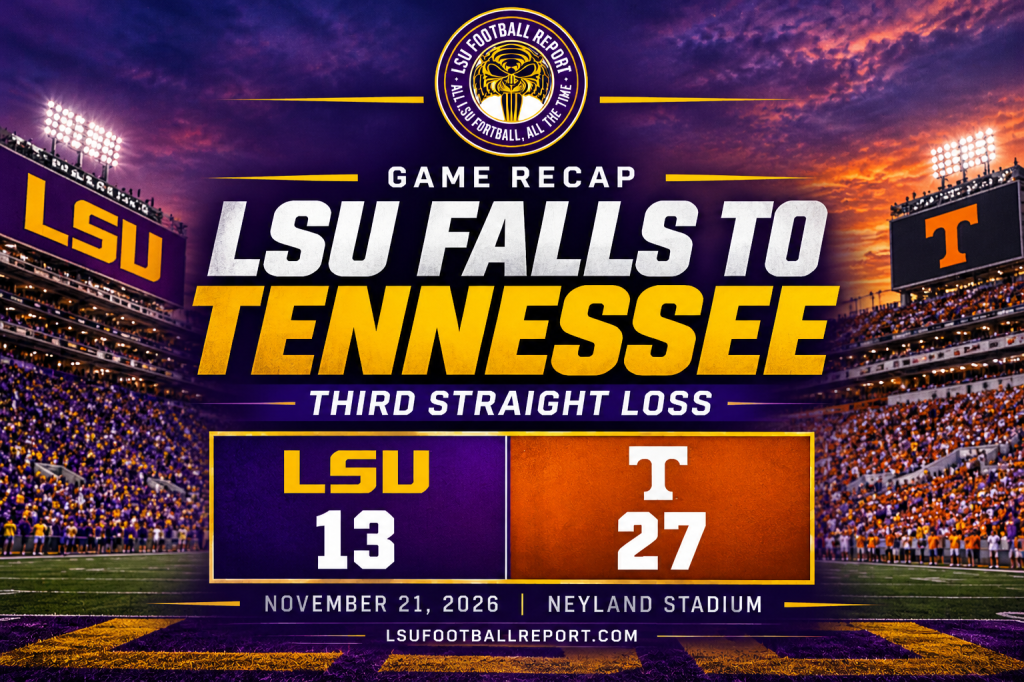
Another Saturday, another frustrating LSU loss, and another game that leaves Tiger fans wondering how a team with this much talent continues to make the same mistakes. LSU fell to No. 9 Tennessee 27–13 Saturday afternoon in Knoxville, extending its losing streak to three games and dropping to 6–5 overall and 3–5 in SEC play.
This time, there was no heartbreaking last second touchdown or narrow defeat to explain away. LSU’s offense struggled to move the football, the offensive line repeatedly broke down, and penalties turned promising opportunities into wasted possessions. The Tigers entered the fourth quarter tied at 13, but Tennessee scored the final 14 points to send LSU home with another disappointing defeat.
The most frustrating part? LSU’s defense once again did enough to give the Tigers a chance to win. Unfortunately, the offense could not return the favor.
Sixteen Penalties and Eight Sacks: LSU Couldn’t Get Out of Its Own Way
LSU’s offensive problems began almost immediately and continued throughout the afternoon. The Tigers committed 16 penalties, including eight false starts, while Tennessee’s defense recorded eight sacks against quarterback Sam Leavitt. Those numbers tell the story of an offense that repeatedly sabotaged itself before it could establish any rhythm.
Playing inside a hostile Neyland Stadium certainly presented communication challenges, but LSU is an SEC program accustomed to difficult road environments. The repeated false starts, protection breakdowns and mistakes at the line of scrimmage cannot simply be blamed on crowd noise. At some point, the coaching staff and players must find a way to execute.
The offensive line struggled to protect Leavitt, while snap communication problems contributed to costly mistakes. Center Braelin Moore and Leavitt had a miscommunication early in the game that resulted in a fumble, giving Tennessee possession. Later, another errant snap turned a manageable situation into a drive killing setback.
These were not isolated mistakes. They were symptoms of an offense that has struggled with execution for several consecutive weeks. Against Tennessee, those problems became impossible to overcome.
The Defense Created Opportunities LSU Failed to Capitalize On
LSU’s defense deserves considerable credit for keeping the Tigers competitive despite the offensive struggles. The unit forced three Tennessee turnovers, including an interception by Davhon Keys and a forced fumble and recovery by Ty Benefield.
Those takeaways should have provided LSU with an opportunity to seize control early. Instead, the Tigers managed only two Scott Starzyk field goals in the first quarter, taking a 6–0 lead despite receiving favorable field position.
The defense continued to make important stops throughout the first half. Tennessee struggled to sustain drives, and LSU repeatedly forced the Volunteers into difficult situations. Even after an LSU fumble gave Tennessee possession at the Tigers’ seven yard line, the defense delivered a goal line stand to prevent a touchdown.
But the offense could not take advantage of those opportunities. LSU entered halftime trailing 10–6 despite Tennessee’s offensive struggles, and the inability to turn takeaways into touchdowns became one of the game’s defining problems.
The defense was not flawless, particularly in the fourth quarter, but it kept LSU within striking distance far longer than the offensive production warranted.
Another Red Zone Nightmare
LSU’s inability to finish drives has become one of the most maddening storylines of the season. Against Alabama, the Tigers moved the football but repeatedly failed to convert scoring opportunities. Against Texas, red zone interceptions helped turn a potential signature victory into a one point defeat.
Saturday against Tennessee brought more of the same.
After Benefield recovered a Tennessee fumble and returned it to the Volunteers’ 18 yard line, LSU moved backward because of penalties and settled for a 44 yard field goal. Another promising opportunity ended with a 26 yard Starzyk field goal rather than a touchdown.
Those six points represented missed opportunities to build an early advantage against a Tennessee offense that was struggling to generate consistent production.
LSU’s only touchdown came in the third quarter after Tennessee muffed a punt and PJ Woodland recovered at the Volunteers’ nine yard line. Leavitt connected with Trey’Dez Green on the very next play, tying the game at 13.
That sequence was a welcome example of LSU capitalizing on an opponent’s mistake, but it also highlighted the offense’s larger problem. The Tigers needed a special teams takeaway deep in Tennessee territory to produce their only touchdown of the afternoon.
Championship caliber offenses cannot depend on their defense and special teams to repeatedly manufacture scoring opportunities. LSU must develop the ability to sustain drives and finish them without relying on opponents to provide a short field.
Tennessee’s Fourth Quarter Exposed LSU’s Biggest Problems
With the score tied at 13 entering the fourth quarter, LSU still had every opportunity to leave Knoxville with a victory. The defense had kept Tennessee’s offense under control for much of the afternoon, and one productive offensive possession could have changed the direction of the game.
Instead, Tennessee quarterback Faizon Brandon took over.
Brandon broke loose for an 18 yard touchdown run with 8:22 remaining, completing an 11 play, 63 yard drive that gave the Volunteers a 20–13 advantage. It was the kind of sustained possession LSU had struggled to produce all afternoon.
The Tigers attempted to answer, but Leavitt was stripped of the football while driving into Tennessee territory. The Volunteers recovered with 4:54 remaining, eliminating another opportunity for LSU to tie the game.
Brandon delivered the knockout blow moments later, breaking free for a 55 yard touchdown run that extended Tennessee’s lead to 27–13 with 4:13 remaining.
Just like that, a game tied entering the final quarter became a two touchdown defeat.
LSU’s defense had played well enough to keep the Tigers competitive for three quarters, but the two fourth quarter touchdown runs demonstrated how quickly a game can unravel when the offense cannot sustain possessions and the defense is forced to carry the burden.
Sam Leavitt Never Found a Rhythm
Leavitt finished with 222 passing yards and one touchdown, but those numbers do not adequately describe how difficult the afternoon was for LSU’s quarterback.
Tennessee’s defensive front repeatedly pressured Leavitt, recording eight sacks and forcing him to operate under constant duress. The Tigers managed only 43 rushing yards on 34 attempts, an average of 1.3 yards per carry, leaving the offense without the balance necessary to keep Tennessee’s defense honest.
Leavitt also lost two fumbles, including the costly fourth quarter turnover that helped Tennessee put the game away. Although he connected with Green for LSU’s only touchdown, the passing attack never consistently threatened the Volunteers.
It would be unfair to place the entire responsibility on Leavitt. The protection problems were severe, penalties repeatedly created unfavorable situations, and the offense struggled to establish any rushing threat.
Nevertheless, the quarterback and offensive staff must find a way to execute more effectively. LSU cannot expect to defeat quality SEC opponents while allowing eight sacks and producing only one touchdown.
Lane Kiffin’s Offense Has Become LSU’s Biggest Concern
When Lane Kiffin arrived at LSU, expectations centered on an explosive offense capable of challenging the best defenses in college football. Instead, the Tigers have now scored just 39 combined points against Alabama, Texas and Tennessee.
That is an average of 13 points per game over the last three contests.
The problems have varied from week to week, but the results have been remarkably consistent. Against Alabama, LSU moved the football but failed to finish drives. Against Texas, turnovers and a scoreless fourth quarter allowed the Longhorns to erase an 11 point deficit. Against Tennessee, penalties, sacks and an ineffective rushing attack prevented LSU from establishing any sustained offensive rhythm.
Three different opponents. Three different game situations. Three losses.
The common denominator is an offense that has not consistently executed when the Tigers needed it most.
Kiffin and offensive coordinator Charlie Weis Jr. must take a hard look at the offensive operation. Protection adjustments, communication, play selection and red zone execution all require attention. The talent is there, but talent alone does not win SEC football games.
Special Teams Remain a Mixed Bag
LSU’s special teams have received deserved criticism throughout the season, particularly after costly mistakes against Kentucky and Texas. Saturday offered a mixture of encouraging plays and familiar concerns.
Starzyk converted both of his field goal attempts, connecting from 44 and 26 yards to account for LSU’s first six points. Woodland’s recovery of a muffed Tennessee punt directly set up the Tigers’ only touchdown.
Those were important contributions, and the special teams unit deserves credit for creating a scoring opportunity when LSU desperately needed one.
However, LSU also continued to experience punting difficulties. Grant Chadwick was replaced by Hayden Craig during the game, illustrating the staff’s ongoing search for greater consistency in that phase.
The positive plays were welcome, but LSU still needs more dependable field position production from its kicking game. Special teams should complement the offense and defense rather than becoming another source of uncertainty.
Three Straight Losses Raise Serious Questions
LSU entered November with an opportunity to finish the season strongly and build momentum toward the postseason. Instead, the Tigers have lost three consecutive games against Alabama, Texas and Tennessee.
The losses have been different in appearance but similar in their underlying problems. LSU has repeatedly struggled to finish drives, protect the football, execute in critical situations and avoid self inflicted mistakes.
Saturday’s performance was particularly concerning because Tennessee committed three turnovers and converted just three of 16 third down attempts. Those are normally the kinds of numbers that provide an opponent with an excellent opportunity to win.
Yet LSU still lost by 14 points.
The Tigers are now 6–5, with their final regular season game against Arkansas approaching. A season that once carried considerable expectations has become a frustrating exercise in identifying what went wrong.
The Bottom Line: LSU Is Beating Itself
Tennessee deserves credit for its defensive performance and Brandon’s explosive fourth quarter. The Volunteers made the plays necessary to win and took advantage of LSU’s mistakes.
But the Tigers must confront an uncomfortable reality. Sixteen penalties, eight sacks allowed, an ineffective rushing attack and repeated failures to capitalize on turnovers are not the characteristics of a team prepared to compete for championships.
LSU’s defense forced three turnovers and kept the game competitive for three quarters. Starzyk made both of his field goals, and the special teams unit created a touchdown opportunity. Those were legitimate positives in an otherwise disappointing afternoon.
Unfortunately, they were not enough to overcome an offense that continues to struggle with fundamental execution.
The Tigers have now lost three straight games, and the explanations are becoming painfully familiar. The offensive line cannot consistently protect the quarterback. The offense cannot reliably finish drives. Penalties repeatedly erase opportunities. And when the fourth quarter arrives, LSU has struggled to deliver the plays necessary to win.
At some point, missed opportunities stop being bad luck and become a reflection of how a team plays. For LSU, that point has arrived.
Sources
- LSU Athletics: Football Struggles Offensively, Falls to No. 9 Tennessee, 27–13
- Tennessee Athletics: LSU vs. Tennessee Official Game Center and Statistics
- Associated Press: Faizon Brandon’s Two Fourth Quarter Touchdowns Lift Tennessee Past LSU
- WAFB: Tennessee Defeats LSU 27–13 in Knoxville
- Saturday Down South: Tennessee Defense Locks Down LSU

