
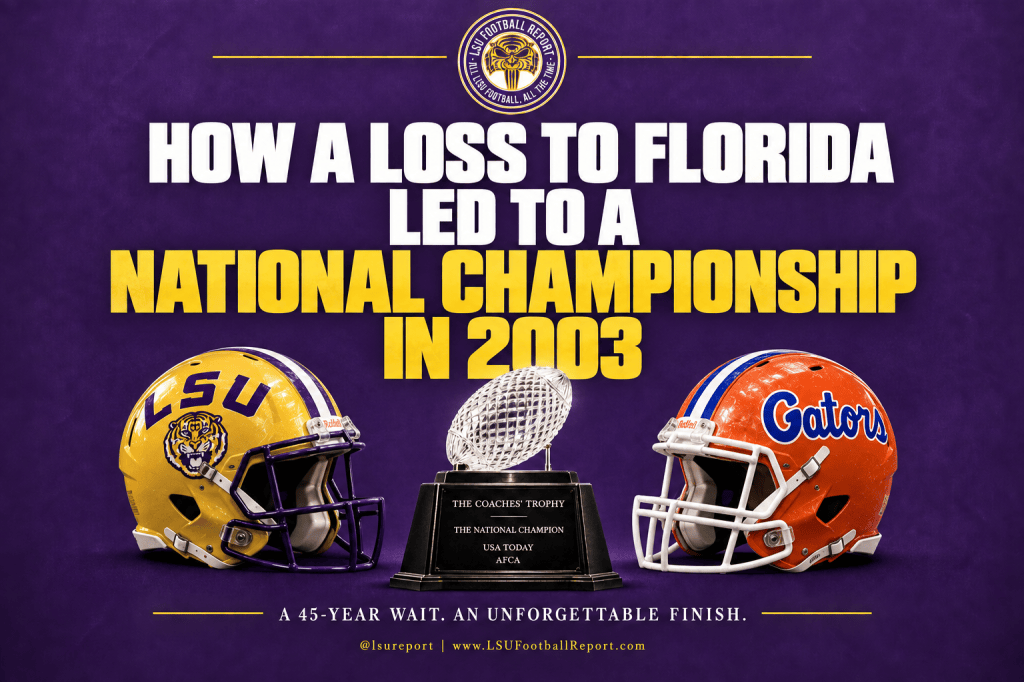
Florida left Tiger Stadium with a victory. LSU was left with questions. On October 11, 2003, a season that had begun with five straight wins suddenly looked far less certain after the Gators beat the sixth-ranked Tigers, 19–7.
Less than three months later, LSU celebrated its first national championship in 45 years. The same team that failed to score an offensive touchdown against Florida finished 13–1, won the SEC and defeated Oklahoma for the BCS national title.
The Florida loss remained on the record. It never became the verdict on the season.
An afternoon that shook championship hopes
LSU had already given its fans reasons to believe something special was developing. Nick Saban’s Tigers beat Georgia, 17–10, in September, then overwhelmed Mississippi State, 41–6, to reach 5–0.
Florida arrived in Baton Rouge with a 3–3 record. When Skyler Green returned a punt 80 yards for a touchdown in the first quarter, LSU had an early lead and another opportunity to strengthen its championship case.
Instead, those were the Tigers’ only points.
LSU managed just 56 rushing yards and converted three of 12 third downs. Matt Mauck threw two interceptions, and the offense never produced a scoring drive. Florida freshman quarterback Chris Leak threw two touchdown passes as the Gators scored 19 unanswered points.
There was no need to manufacture reasons for concern. An undefeated, highly ranked team had lost at home to an opponent that entered with as many losses as victories.
LSU’s own historical account describes the aftermath as a crossroads, noting that national championship talk had been interrupted. The SEC championship remained within reach, but the Tigers had to respond immediately.
The response began the following Saturday
LSU could not repair the Florida result. It could improve the football that followed.
A week later, the Tigers traveled to South Carolina and won, 33–7. The offense generated 482 yards, including 263 rushing yards, while the defense held the Gamecocks to zero net rushing yards.
Those numbers offered a concrete answer to the previous week’s concerns. LSU had struggled to run against Florida; at South Carolina, its ground game became a strength.
The Tigers followed with a 31–7 victory over Auburn. In two weeks, LSU had outscored two SEC opponents by a combined 64–14 and moved the conversation back toward what the team could accomplish.
That response matters when remembering the season. LSU did not simply wait for the disappointment to fade. It produced better performances.
Confidence became a winning streak
The victories continued: 49–10 over Louisiana Tech and 27–3 at Alabama. LSU then survived a much tighter test, beating Eli Manning and Ole Miss, 17–14, in Oxford.
The championship run required both kinds of wins. The Tigers could overwhelm opponents, but they also had to handle a game in which one possession separated success from another damaging defeat.
LSU closed the regular season by beating Arkansas, 55–24. The team that had left the Florida game at 5–1 was now 11–1, with six consecutive victories and an opportunity to win the SEC championship.
Florida had exposed weaknesses. The weeks afterward showed that those weaknesses did not have to define LSU.
From Atlanta to the national championship game
The SEC Championship Game brought another meeting with Georgia. LSU had won the September matchup by a touchdown; the rematch was a 34–13 statement.
Freshman running back Justin Vincent supplied one of its defining plays, an 87-yard touchdown run. His emergence gave the Tigers an increasingly dangerous rushing threat as the season reached its most important games.
LSU’s seventh straight victory secured the conference championship. The Tigers then earned a place opposite Oklahoma in the BCS title game at the Sugar Bowl.
The championship system was controversial: USC ultimately finished No. 1 in the Associated Press poll, while LSU won the BCS championship and finished atop the coaches’ poll. LSU’s achievement was its first national title since the 1958 season.
The defense finished the job
On January 4, 2004, LSU defeated Oklahoma, 21–14, in the Superdome. The Tigers held the Sooners to 154 total yards, including only 52 rushing yards.
Oklahoma completed just 13 of 37 passes, threw two interceptions and surrendered five sacks. Marcus Spears delivered one of the night’s biggest plays, returning an interception 20 yards for a touchdown early in the third quarter.
Green and Vincent also scored rushing touchdowns. LSU built a 21–7 lead, then protected it as Oklahoma threatened late.
The Tigers had won eight consecutive games since losing to Florida. A season that briefly raised uncomfortable questions ended with a championship trophy and a 13–1 record.
What that season still says about one loss
The lesson of 2003 is not that every disappointing Saturday will lead to a championship. LSU earned that ending through a sustained response: better offensive production, decisive defensive performances and victories in the games it could not afford to lose.
Nor does remembering the championship require pretending the Florida performance was acceptable. It was a poor afternoon for an excellent team. Both facts belong in the story.
That is what makes the season worth remembering after a difficult loss. A team’s flaws deserve attention, but an early setback cannot tell the entire story of what that team might become.
Florida beat LSU that October. Eight wins later, LSU ended a 45-year championship wait.
Sources
- LSU Athletics. 2003 Football Schedule
. Season results and winning streak. (lsusports.net
)
- LSU Athletics. Florida vs. LSU, October 11, 2003: Official Statistics
. Florida game scoring and statistics. (static.lsusports.net
)
- LSU Athletics. LSU Football Championship Seasons
. Post-Florida uncertainty, South Carolina response and BCS context. (lsusports.net
)
- LSU Athletics. IN FOCUS: LSU’s 2003 Football National Champions
. Championship history and Vincent’s SEC title-game touchdown. (lsusports.net
)
- LSU Athletics. LSU vs. Oklahoma, January 4, 2004: Official Statistics
. Sugar Bowl scoring and statistics. (static.lsusports.net
)

