
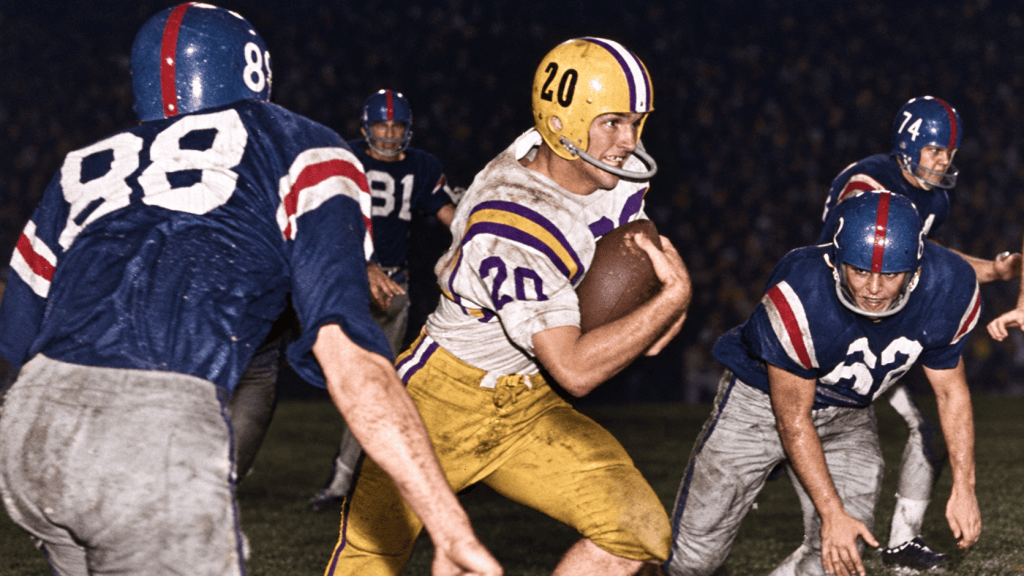
Some touchdowns decide games. A rare few become part of a program’s identity.
On Halloween night in 1959, Billy Cannon fielded an Ole Miss punt at the LSU 11-yard line and carried it 89 yards into college football history. His fourth-quarter touchdown gave top-ranked LSU a 7–3 victory over No. 3 Ole Miss in Tiger Stadium.
More than six decades later, Cannon’s run remains one of the defining moments in LSU football history.
A battle between unbeaten powers
The October 31 meeting brought together two 6–0 teams with national championship ambitions. LSU was the defending national champion, while Ole Miss had built one of the most dominant teams in school history.
Both defenses had been nearly impossible to score against. LSU had outscored its first six opponents 103–6. Ole Miss had outscored its opponents 189–7. Together, the teams had allowed only 13 points entering the game.
The matchup lived up to its billing.
LSU struggled to protect the football during the first half, losing three fumbles. One of them came at the LSU 21-yard line and helped Ole Miss move into position for a field goal by Robert Khayat.
That kick gave the Rebels a 3–0 lead. It remained the only score through the first three quarters.
Cannon did everything LSU needed
Cannon was much more than a running back. In the one-platoon era, he contributed on offense, defense and special teams.
During the third quarter, Cannon intercepted an Ole Miss pass and gave LSU favorable field position. The Tigers advanced to the Ole Miss 20 but came away without points after missing a field-goal attempt.
Ole Miss coach Johnny Vaught repeatedly used quarterback and punter Jake Gibbs to control field position. Gibbs sometimes punted before fourth down, trusting the Rebels’ defense and forcing LSU to handle the football on a damp field.
The strategy kept the Tigers trapped. Then LSU tackle Lynn LeBlanc changed the situation by dropping Gibbs for a 10-yard loss. Ole Miss faced third-and-17 from its own 42-yard line and eventually sent Gibbs out to punt.
That decision gave Cannon his opportunity.
The run
Gibbs produced a 47-yard punt intended to travel out of bounds. Instead, the football took a high bounce toward Cannon at the LSU 11.
Cannon fielded it inside the 15-yard line, an area where LSU coach Paul Dietzel normally instructed his returners to leave the ball alone. With LSU trailing and time beginning to disappear, Cannon attacked.
An Ole Miss defender hit him near the 15, but Cannon regained his balance. More Rebels reached him as he powered up the field, yet he kept breaking free. LSU’s official player biography credits Cannon with breaking seven tackles during the return.
Once Cannon escaped the main group of defenders, Gibbs remained between him and the end zone. Cannon beat the punter and finished the 89-yard return.
Exactly 10 minutes remained when he crossed the goal line. The extra point gave LSU a 7–3 lead.
Tiger Stadium erupted, and Cannon had produced the signature play of his remarkable career.
Ole Miss nearly answered
The game was not over. Ole Miss took possession at its own 32-yard line and controlled the football for the next nine minutes and 42 seconds.
Quarterback Doug Elmore directed the Rebels down the field, eventually reaching the LSU 2-yard line. Ole Miss faced fourth-and-goal with the game hanging in the balance.
Guard John Langan slowed Elmore near the line of scrimmage. Warren Rabb stopped his forward progress, and Cannon helped finish the tackle at the LSU 1-yard line.
Eighteen seconds remained. LSU took possession and secured the 7–3 victory.
Cannon had supplied the winning touchdown, intercepted a pass and helped preserve the victory at the goal line. LSU’s detailed retrospective credits him with 48 rushing yards on 12 carries, 102 yards on three punt returns, four punts averaging 42 yards and approximately six tackles.
It was a complete performance from a complete football player.
The defining moment of a Heisman season
Cannon entered the game as an established star. He had helped LSU complete an 11–0 national championship season in 1958 and had finished third in that year’s Heisman Trophy voting.
His 1959 campaign added another remarkable collection of achievements. Cannon led LSU with 598 rushing yards on 139 carries and scored five rushing touchdowns. He also returned 15 punts for 221 yards, intercepted four passes and produced 145 yards on those interception returns.
At the end of the season, Cannon won the Heisman Trophy. He was also recognized as a consensus All-American and earned national player-of-the-year honors from the Associated Press, United Press International and The Sporting News.
LSU retired his No. 20 jersey, and Cannon was inducted into the College Football Hall of Fame in 2008.
The play that never gets old
LSU’s 1959 season did not end with a national championship. The Tigers lost 14–13 at Tennessee the following week, ending their 19-game winning streak. LSU finished 9–2 after Ole Miss won a 21–0 rematch in the Sugar Bowl.
None of that erased Halloween night.
The black-and-white footage remains woven into LSU football culture. Cannon fields the bouncing punt, drives through the coverage and emerges from the crowd with nothing but open field ahead of him.
The outcome never changes. Ole Miss has the lead. LSU needs a play. Billy Cannon takes the ball at the 11 and runs 89 yards into immortality.
Sources
- LSU Athletics — The Halloween Run: 50 Years Later
- LSU Athletics — Billy Cannon Player Biography and Statistics
- Heisman Trophy — A Trick or Treat Story About Billy Cannon’s Halloween Run
- National Football Foundation — Billy Cannon Hall of Fame Profile
- Ole Miss Athletics — Football History vs. LSU
- Sports Reference — Ole Miss at LSU, October 31, 1959

