
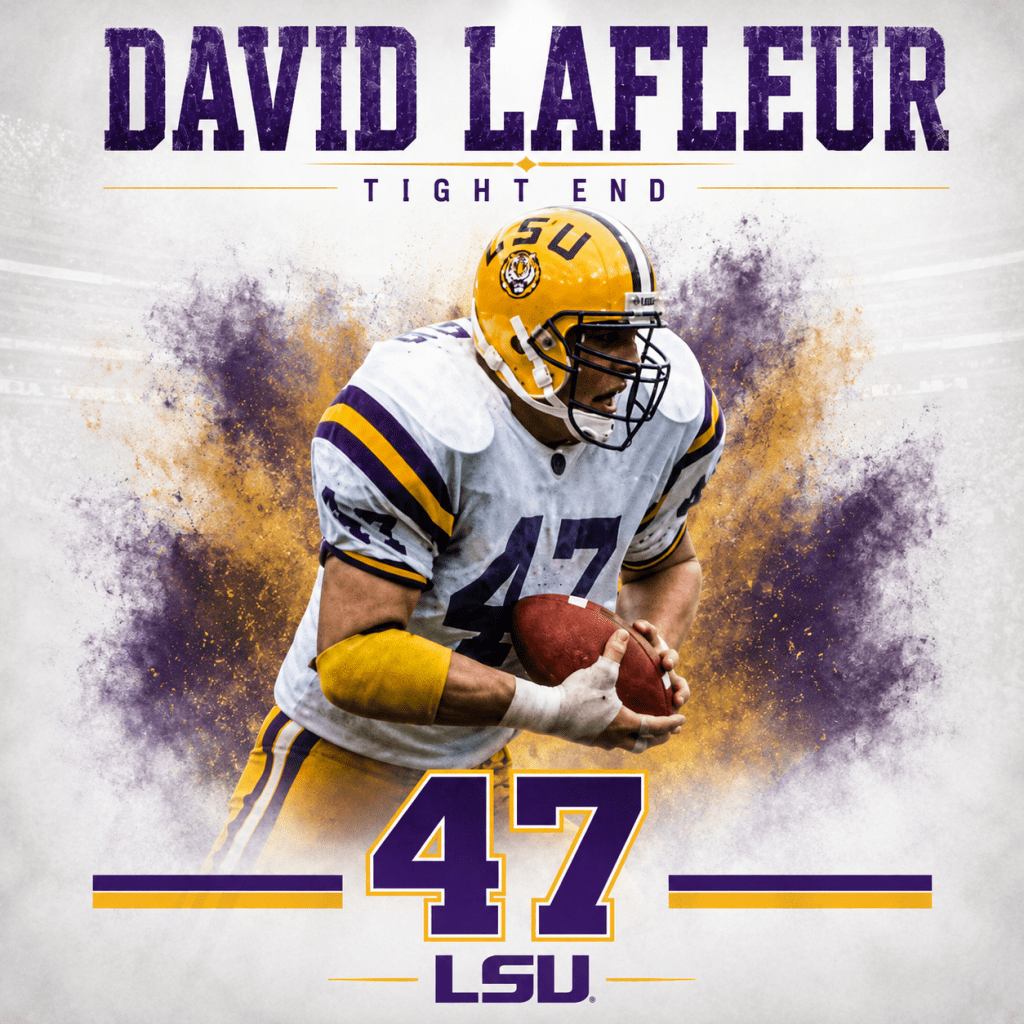
David LaFleur was built like an offensive lineman but could catch the football like a receiver. At 6’7” and more than 270 pounds, he developed into one of the premier tight ends in college football and one of the best to play the position at LSU.
From 1993 through 1996, LaFleur caught 71 passes for 881 yards and five touchdowns. He earned first team All SEC honors twice, became a first team All American as a senior and led LSU in receiving in 1996. His combination of size, blocking ability and receiving talent eventually made him a first round NFL Draft selection.
That complete résumé earns David LaFleur the No. 97 spot among the Top 100 Tigers of All Time.
A Louisiana Star Stays Home
LaFleur grew up in Westlake, Louisiana, near Lake Charles, and played at Westlake High School before coming to LSU.
His college career almost began with disaster. LaFleur suffered a severe ankle fracture during a scrimmage just before the 1992 season and redshirted as a true freshman.
He returned in 1993 and spent much of his first playing season behind veteran tight end Harold Bishop. LaFleur still contributed eight receptions for 59 yards.
The following season, LSU began to see just how good its young tight end could become.
Breaking Out in 1994
LaFleur emerged as one of LSU’s most important offensive players during his sophomore season.
He caught 21 passes for 263 yards and two touchdowns in 1994. Those statistics do not look enormous compared with the numbers produced in modern passing offenses, but LaFleur played in an era when tight ends were expected to be major contributors to the running game as blockers.
His performance earned him first team All SEC honors from the conference coaches, Associated Press and Football News. UPI also selected him as an honorable mention All American.
By the end of his sophomore season, LaFleur had established himself as one of the SEC’s best tight ends.
Fighting Through an Injury in 1995
Expectations were high entering 1995, but an early season knee injury slowed LaFleur and cost him playing time.
He finished his junior season with 12 receptions for 120 yards. Although his receiving production declined, his value to LSU went well beyond the statistics.
LaFleur was not simply a large receiver playing tight end. His size and strength allowed him to function as an important blocker at the line of scrimmage while still presenting defenses with a dangerous receiving target.
He returned healthy for his senior season, and everything came together.
LSU’s Leading Receiver
LaFleur produced the best season of his college career in 1996.
He started every game and led LSU with 30 receptions for 439 yards and three touchdowns. His 14.6 yards per reception demonstrated that he was capable of making plays downfield rather than simply catching short passes around the line of scrimmage.
LaFleur became the first LSU tight end since Greg LaFleur in 1980 to lead the Tigers in receptions. His 439 receiving yards also established an LSU single season record for a tight end at the time.
One of his biggest plays came against Ole Miss, when he caught a career long 59 yard pass that set up an LSU touchdown. He caught five passes for 76 yards against Kentucky and five for 54 yards and a touchdown against New Mexico State. Against Houston, he turned two receptions into 69 yards.
Those numbers made LaFleur LSU’s leading receiver, but they tell only part of the story.
A Major Part of LSU’s Running Game
LaFleur was also an outstanding blocker.
LSU Athletics credits him with playing an important role in the Tigers finishing 1996 as the SEC’s top rushing team. That offense featured Kevin Faulk and Rondell Mealey and helped LSU finish the season 10 and 2. The Tigers capped the year with a 10 to 7 victory over Clemson in the Peach Bowl.
That is what made LaFleur such a difficult player to defend.
If LSU ran the football, he had the size and strength to contribute as a blocker. If the Tigers threw, his 6 foot 7 frame created a major matchup problem for linebackers and defensive backs.
He was a true all around tight end.
One of the Best Tight Ends in America
LaFleur’s senior season earned him national recognition.
The Walter Camp Football Foundation selected him as its first team All America tight end for 1996. The Associated Press named him a third team All American. He was also named first team All SEC by both the conference coaches and Associated Press.
Those honors followed his first team All SEC selection two years earlier, giving LaFleur first team conference recognition in both 1994 and 1996.
He finished his LSU career with 71 receptions for 881 yards and five touchdowns. LSU’s historical record book later listed his 881 receiving yards as second among Tigers tight ends, behind only Richard Dickson’s 952.
More important than the raw totals was the type of player LaFleur had become. He could catch, block and stretch the field while possessing the size of an offensive lineman.
NFL teams noticed.
A First Round NFL Draft Pick
The Dallas Cowboys selected LaFleur with the 22nd overall pick in the first round of the 1997 NFL Draft.
LaFleur spent his entire four year NFL career with Dallas. From 1997 through 2000, he appeared in 60 regular season games and started 44. He caught 85 passes for 729 yards and 12 touchdowns.
His best statistical season came in 1999. LaFleur started all 16 games and caught 35 passes for 322 yards and seven touchdowns. The seven receiving touchdowns were easily the best total of his NFL career.
His professional career ended after the 2000 season, far sooner than might have been expected for a player selected in the first round.
Still, reaching the NFL as the 22nd overall selection demonstrates just how highly professional scouts regarded the player LSU had developed.
A Tight End Built for Any Era
LaFleur played the position differently from many modern tight ends.
Today, tight ends are often evaluated first by receptions, yards and touchdowns. During LaFleur’s LSU career, blocking was a fundamental part of the job.
LaFleur excelled at both.
At 6 foot 7 and roughly 270 pounds, he could help move defenders in the running game. He also possessed enough receiving ability to lead LSU in catches and receiving yards during his senior season.
That combination made his 1996 performance particularly impressive.
LSU’s leading receiver was simultaneously an important blocker for the SEC’s leading rushing offense.
There are not many players who can make that claim.
Why David LaFleur Is No. 97
David LaFleur’s LSU career deserves to be remembered as more than a collection of receiving statistics.
He caught 71 passes for 881 yards and five touchdowns. He earned first team All SEC honors twice. He became a first team All American. He led LSU in receiving as a senior while helping the Tigers field the SEC’s top rushing attack.
Then the Dallas Cowboys made him the 22nd overall selection in the NFL Draft.
LaFleur was one of the most complete tight ends LSU has produced. He could block like an additional offensive lineman, provide a huge target in the passing game and make plays downfield when LSU needed them.
His senior season remains one of the great tight end seasons in LSU history.
That earns David LaFleur the No. 97 spot among the Top 100 Tigers of All Time.
Sources
LSU Athletics, David LaFleur official biography
https://lsusports.net/sports/fb/roster/season/1993/player/david-lafleur/
LSU Athletics, LSU Football First Team All Americans
https://lsusports.net/lsu-football-first-team-all-americans
LSU Athletics, LSU Football Annual Statistical Leaders
https://lsusports.net/news/2019/07/11/204777969
LSU Athletics, LSU Football Record Book
https://static.lsusports.net/assets/docs/fb/pdf/13guide.pdf
Pro Football Reference, David LaFleur NFL statistics
https://www.pro-football-reference.com/players/L/LaFlDa00.htm
Pro Football Reference, 1997 Dallas Cowboys Draft
https://www.pro-football-reference.com/teams/dal/1997_draft.htm

