
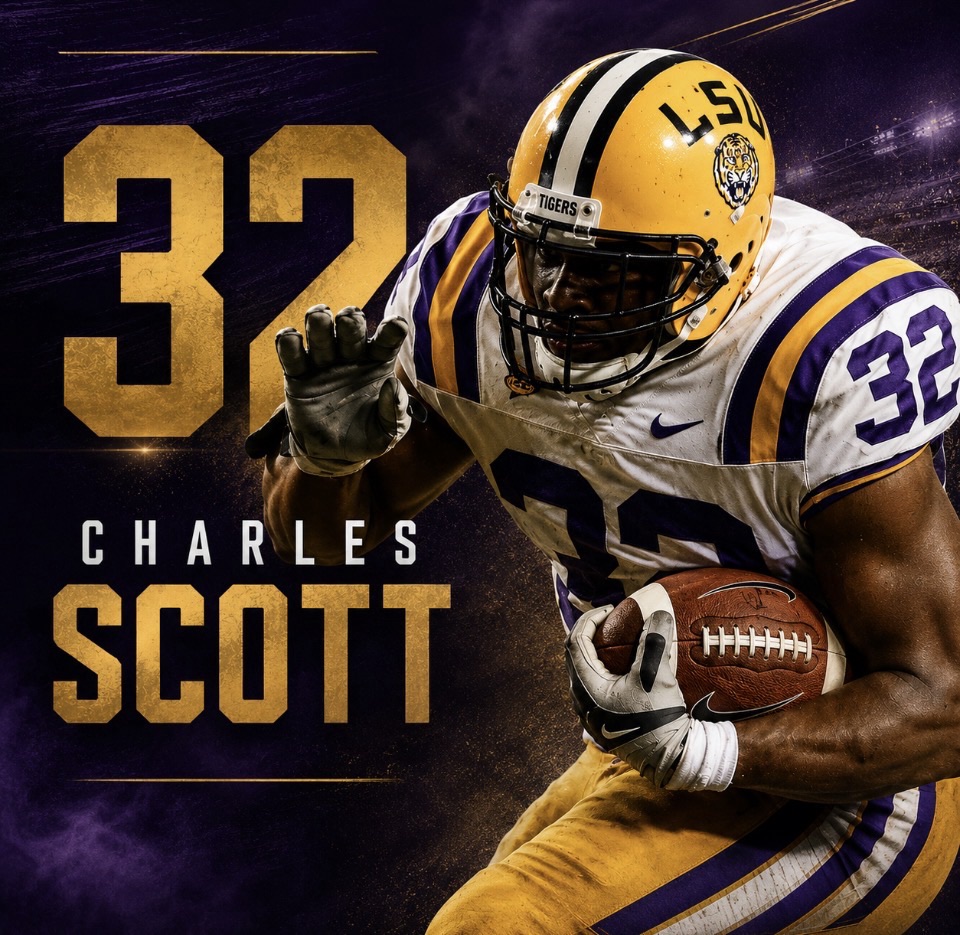
Charles Scott deserves a bigger place in the conversation about great LSU running backs. He was powerful enough to run through SEC linebackers, quick enough to turn a crease into a long gain and productive enough to finish his career with 2,317 rushing yards and 32 rushing touchdowns. He accomplished that despite spending his first two seasons in crowded LSU backfields and losing the final four games of his senior season to injury.
At his peak, Scott was one of the best running backs in the SEC. His 2008 season produced 1,174 rushing yards and a conference leading 18 rushing touchdowns. He earned first team All SEC honors from the league coaches, helped LSU win the national championship the year before and finished his career ranked seventh in LSU history in rushing yards and fourth in rushing touchdowns at the time. Those are not the numbers of an ordinary back. They belong to one of the most productive power runners LSU has ever had.
A Louisiana High School Superstar
Charles Edward Scott Jr. was born August 8, 1988, in Tampa, Florida, but his football story became a Louisiana story. He attended Jonesboro Hodge High School and developed into one of the top prospects in the state.
Scott was dominant as a senior. He rushed for 2,039 yards and 28 touchdowns while averaging 8.2 yards per carry. That followed a junior season in which he rushed for 1,672 yards and 18 touchdowns.
The awards reflected his production. Scott was named Louisiana Mr. Football and Louisiana Gatorade Player of the Year. He also earned first team All America recognition from Sports Illustrated and was considered one of the top running back prospects in the country.
Scott was more than a running back. He also played linebacker and defensive back during his high school career and earned All District recognition in baseball and basketball. Jonesboro Hodge reached the Class 2A quarterfinals during his senior season.
LSU was getting one of Louisiana’s best football players and one of its best overall athletes.
An Immediate Impact at LSU
Scott did not have to wait long to prove that his high school production could translate to the SEC.
As a true freshman in 2006, he appeared in seven games and rushed 46 times for 277 yards and five touchdowns. He averaged 6.0 yards per carry despite playing behind more experienced backs.
His first major performance came against Tulane. Scott carried 15 times for 101 yards and two touchdowns. According to LSU, he became the quickest Tiger true freshman to reach 100 rushing yards in a game since Kevin Faulk accomplished it in his second game in 1995.
Scott also made his first career start that season against Mississippi State.
LSU already had a loaded backfield, so there was no need to force Scott into a featured role. What he demonstrated immediately was that when LSU gave No. 32 the football, good things tended to happen.
A National Champion in 2007
Scott’s sophomore season put him in the middle of one of the greatest years in LSU football history.
The Tigers finished 12 and 2, won the SEC championship and defeated Ohio State 38 to 24 in New Orleans to capture the BCS national championship.
Jacob Hester was LSU’s leading rusher, while Keiland Williams was another major part of a deep backfield. Scott received only 45 carries during the entire season.
He made them count.
Scott rushed for 324 yards and five touchdowns while averaging an outstanding 7.2 yards per carry. He also caught 12 passes for 115 yards and two touchdowns. That gave him seven offensive touchdowns despite recording only 57 combined carries and receptions.
Scott contributed in the national championship victory as well, catching a 16 yard pass against Ohio State.
The national championship ring was secured. The following season, Scott finally received his opportunity to become LSU’s featured running back.
The 2008 Explosion
This is the season that should define Charles Scott’s place in LSU history.
Scott started all 13 games and carried 217 times for 1,174 yards. He averaged 5.4 yards per carry and scored 18 rushing touchdowns.
Those 18 touchdowns led the SEC and tied for seventh nationally. At the time, Scott finished only one rushing touchdown short of the LSU season record of 19 established by LaBrandon Toefield in 2001.
Scott became just the 12th LSU player to rush for 1,000 yards in a season. His 1,174 yards ranked fifth in school history at the time.
He was remarkably consistent as well. Scott rushed for at least 100 yards six times during the season and opened the year with four consecutive 100 yard games. He became the first LSU running back to accomplish that since Charles Alexander in 1978.
Through those first four games alone, Scott had already rushed for 535 yards.
This was not a season built around one or two enormous performances. Scott was hammering defenses week after week.
He Announced Himself Immediately
Scott wasted no time establishing what kind of season 2008 would become.
Against Appalachian State in the opener, Scott carried only 16 times but rushed for a career best 160 yards. He scored two touchdowns and broke a career long 56 yard run as LSU won 41 to 13.
One week later, he needed only seven carries to rush for 102 yards against North Texas.
Then came SEC football.
Scott kept producing.
Making History at Auburn
LSU traveled to Auburn on September 20, 2008, for a physical SEC West battle. Scott carried 21 times for 132 yards as LSU rallied for a 26 to 21 victory.
The performance made LSU history. Scott became the first LSU player to rush for 100 yards in a game at Auburn.
He was named SEC Offensive Player of the Week for the performance.
Scott followed it with another 100 yard game against Mississippi State, extending his streak to four consecutive games to begin the season. LSU had found its offensive centerpiece, and SEC defenses were having trouble stopping him even when they knew the Tigers wanted to run the football.
Built for SEC Football
Scott was listed at 5 feet 11 and 233 pounds during his junior season. By his senior year, LSU listed him at 6 feet and 234 pounds.
His strength was obvious. Scott could run through arm tackles, push piles forward and punish defensive backs who tried to tackle him high. But describing him simply as a bruising runner does not fully explain what made him so effective.
Scott had vision, balance and surprising acceleration for a back his size. Once he reached the second level, he could turn a successful run into a big one.
That combination made him almost perfectly suited for SEC football.
Against Georgia in 2008, Scott rushed for 144 yards and two touchdowns on 21 carries. Against Alabama, he finished with 92 yards and two touchdowns. Against Tulane, he needed only 12 carries to produce 114 yards.
Then LSU reached the Chick fil A Bowl against Georgia Tech.
Scott finished his breakout season by scoring a career best three rushing touchdowns in LSU’s 38 to 3 victory.
His final numbers were 1,174 rushing yards and 18 touchdowns. SEC coaches selected him first team All SEC, while the Associated Press named him second team All SEC.
Scott had gone from sharing carries in LSU’s championship backfield to becoming one of the best running backs in the conference.
Scott Chooses LSU Over the NFL
After his breakout junior season, Scott had a decision to make. He could enter the 2009 NFL Draft or return to LSU for his senior season.
Scott chose LSU.
He had already accumulated 1,775 rushing yards and 28 rushing touchdowns through three seasons. He was also approaching his college degree and publicly explained that finishing his education and returning to help lead LSU were important to him.
Scott entered 2009 on the watch lists for the Maxwell Award and Doak Walker Award. He had an opportunity to climb even higher in LSU’s record book and improve his professional prospects.
Unfortunately, his senior season would end much differently than he hoped.
Delivering Against Georgia
One of Scott’s defining senior performances came on the road against Georgia.
LSU entered the October 3 game ranked No. 4 and found itself in a defensive battle in Athens. Scott carried 19 times for 95 yards and scored two touchdowns.
Both scores came when LSU desperately needed them.
Scott scored from two yards out to give LSU a late lead. After Georgia answered, LSU got the football back and Scott broke loose for a 33 yard touchdown with 46 seconds remaining.
LSU won 20 to 13.
Scott earned SEC Offensive Player of the Week honors for the second time in his career. He also surpassed 2,000 career rushing yards during the game.
It was the type of performance that captured Scott at his best. When LSU needed the football moved in the biggest moments, No. 32 delivered.
His LSU Career Ends at Alabama
Scott entered LSU’s November 7, 2009, game against Alabama with an opportunity to continue climbing the school record book.
He was running well, gaining 83 yards on 13 carries. In the third quarter, Scott broke loose for what LSU initially recorded as a 34 yard run.
Then his LSU career ended.
Scott suffered a fractured clavicle on the play. The injury required surgery and ended his senior season after nine games.
It was a brutal ending for a player who had returned to LSU rather than entering the NFL Draft after his outstanding junior year. Scott finished his senior season with 542 rushing yards and four touchdowns on 116 carries. He also caught eight passes for 54 yards and another touchdown.
He never played another down for LSU.
The Numbers Tell the Story
Scott appeared in 43 games and made 23 starts during his LSU career.
His official season totals were 46 carries for 277 yards as a freshman, 45 for 324 as a sophomore, 217 for 1,174 as a junior and 116 for 542 as a senior.
Those four seasons produced 2,317 rushing yards and 32 rushing touchdowns.
There is an important statistical discrepancy in LSU’s online biography. The individual season totals add to 424 rushing attempts, while the career total displayed in one LSU table lists 434. Other contemporary records, including the New York Giants biography after Scott entered the NFL, also list 434. Because the underlying LSU season totals clearly add to 424, the safest way to describe Scott’s career is by the undisputed yardage and touchdown totals rather than relying on the conflicting career attempt figure.
Scott also caught 31 passes for 260 yards and three touchdowns.
He produced eight career 100 yard rushing games and 11 games with multiple rushing touchdowns. At the conclusion of his career, his eight 100 yard performances were tied with Harvey Williams for fourth in LSU history.
Those numbers become even more impressive when Scott’s circumstances are considered. He received only 91 carries during his first two seasons because LSU had exceptionally deep backfields. His senior season then ended after nine games.
His only complete season as LSU’s featured running back produced 1,174 yards and 18 touchdowns.
That is why Charles Scott deserves to be remembered among LSU’s great backs.
The NFL
Scott’s fractured clavicle complicated his preparation for professional football, but his LSU career was still enough to get him drafted.
The Philadelphia Eagles selected him in the sixth round of the 2010 NFL Draft with the 200th overall pick.
His time in Philadelphia was brief. Before the regular season, the Eagles traded Scott to the Arizona Cardinals for cornerback Jorrick Calvin, who had been selected one pick after Scott in the same draft.
Arizona released Scott during final roster cuts. The New York Giants then signed him to their practice squad.
Scott spent the 2010 season in the Giants organization and returned to compete for a roster spot in 2011. The Giants waived him during their final cuts on September 2, 2011.
He never appeared in an NFL regular season game.
Scott’s professional career was brief, but the NFL was never where his football legacy was built.
That happened in Baton Rouge.
Life After Football
One of the most important things Scott did after leaving LSU was finish what he had started academically. He returned to LSU after beginning his professional football career and completed his college education.
That accomplishment fit the reasoning Scott had given when he decided to return for his senior season. LSU had become more than a stop on the way to professional football. He wanted the degree as well as the football career.
Scott’s accomplishments were later recognized by the Jackson Parish Sports Hall of Fame. It was a fitting honor for a player who had gone from dominating Louisiana high school football at Jonesboro Hodge to becoming an All SEC running back and national champion at LSU.
Charles Scott Deserves His Place Among LSU’s Great Backs
LSU has produced an extraordinary collection of running backs. Billy Cannon, Charles Alexander, Dalton Hilliard, Harvey Williams, Kevin Faulk, Joseph Addai, Leonard Fournette, Derrius Guice and others have created one of the richest traditions at the position in college football.
Charles Scott belongs in that history.
He did not finish with the career rushing total of Faulk. He did not receive the national attention that later surrounded Fournette. His professional career did not develop the way he hoped.
But look at what Scott actually accomplished at LSU.
He won a national championship and became a first team All SEC running back. He rushed for 2,317 yards and 32 touchdowns despite spending two years sharing a loaded backfield and losing the final four games of his senior season.
When LSU finally gave him a full season as its featured runner, Scott responded with 1,174 yards and 18 touchdowns. Nobody in the SEC scored more rushing touchdowns that season.
Scott was not simply a big running back. He was a 230 pound runner with vision, balance, acceleration and the ability to punish defenders. At his best, he could take over a football game.
For one memorable stretch in Baton Rouge, No. 32 was one of the most dangerous running backs in the SEC.
Charles Scott was a national champion, an All SEC star and one of the most productive power backs LSU has ever put on the field.
He deserves to be remembered that way.
Sources
LSU Athletics, Charles Scott official biography, career statistics and awards
https://lsusports.net/sports/fb/roster/player/charles-scott/
LSU Athletics, 2009 LSU Football Media Guide
https://static.lsusports.net/assets/docs/fb/pdf/09guide.pdf
LSU Athletics, Charles Scott and Ciron Black announce their return for the 2009 season
https://lsusports.net/news/2009/01/14/3645955/
Pro Football Reference, 2010 NFL Draft
https://www.pro-football-reference.com/years/2010/draft.htm
New York Giants, Charles Scott joins the Giants practice squad
https://www.giants.com/news/long-shots-to-big-shots-5116359
New York Giants, 2011 transactions
https://www.giants.com/team/transactions/2011

