
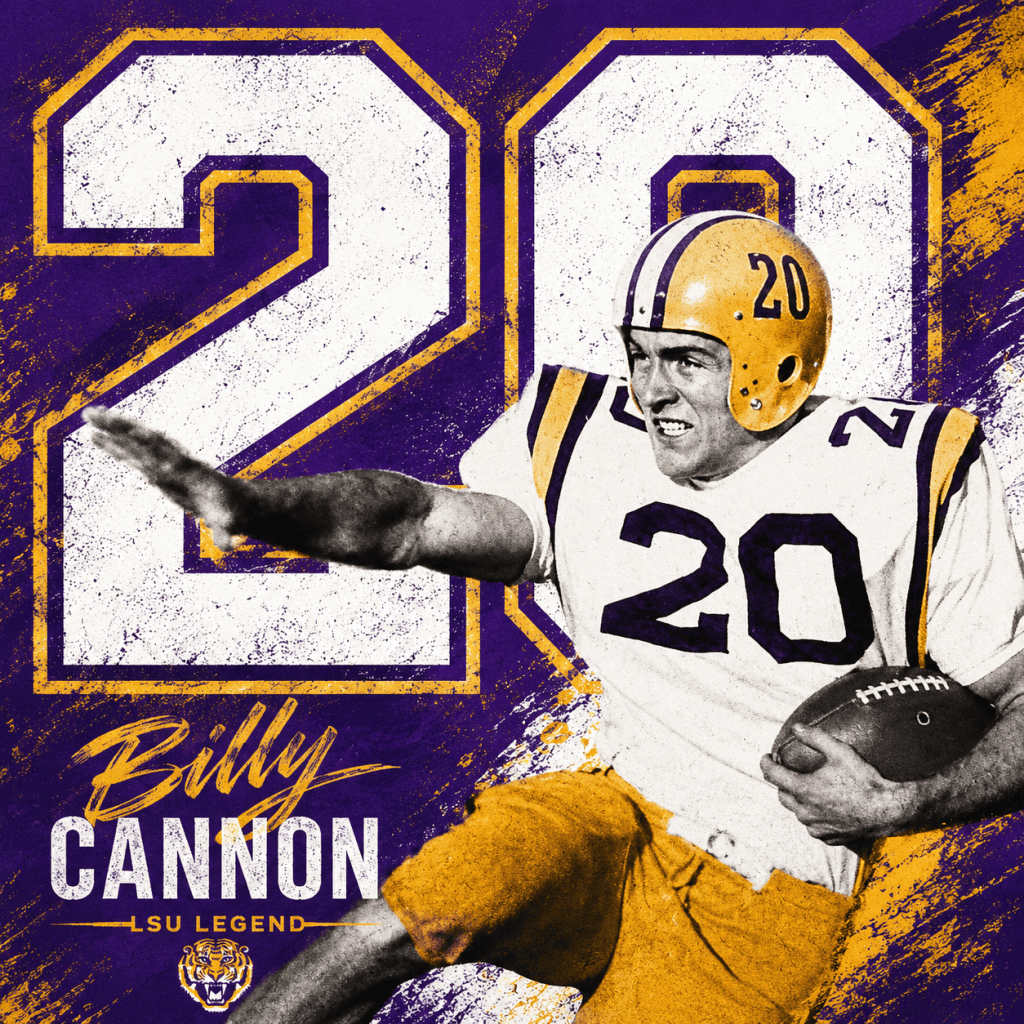
Billy Cannon is one of the most important figures in LSU football history, but his story cannot be told through football alone. He helped lead LSU to a national championship, won the school’s first Heisman Trophy and produced perhaps the most famous play in program history. He then became one of the early stars of the American Football League, winning championships with Houston before successfully reinventing himself as a tight end with Oakland.
His life after football was far more complicated. Cannon became a dentist, went to federal prison after becoming involved in a counterfeiting conspiracy and later rebuilt his professional life. He eventually spent more than two decades providing dental care at the Louisiana State Penitentiary at Angola. Nearly eight years after Cannon’s death, President Donald Trump granted him a full and unconditional posthumous pardon in February 2026.
A Baton Rouge Star Before LSU
William Abb Cannon was born August 2, 1937, in Philadelphia, Mississippi, but grew up in Baton Rouge. He attended Istrouma High School, where he developed into an exceptional athlete in football and track before deciding to remain close to home and attend LSU.
Freshmen were not eligible for varsity football at the time, so Cannon played three varsity seasons at LSU from 1957 through 1959. At 6 feet 1 and around 200 pounds as a senior, he combined unusual power with elite speed. LSU credits him with consistently running the 100 yard dash in about 9.5 seconds.
Cannon was also much more than a runner. He played offense and defense, returned kicks and punts and handled punting duties. That versatility was essential in an era when many of college football’s best athletes contributed in several phases of the game.
The 1958 National Championship
Cannon became a national star during his junior season in 1958. LSU went undefeated under head coach Paul Dietzel and captured the national championship, finishing the season 11 and 0 after defeating Clemson in the Sugar Bowl.
Cannon was one of the driving forces behind the championship run. He led LSU with 686 rushing yards and 10 rushing touchdowns during the regular season, while also contributing as a receiver, returner, punter and defensive back. He earned consensus All America recognition and finished third in the Heisman Trophy voting.
LSU completed its perfect season against Clemson on January 1, 1959. The Tigers won 7 to 0, with Cannon playing a role in every point. He threw a 9 yard touchdown pass to Mickey Mangham and then kicked the extra point. Cannon earned Sugar Bowl Most Valuable Player honors.
A perfect season and national championship would have been enough to make Cannon an LSU legend. His senior season made him something more.
The Halloween Run
On October 31, 1959, top ranked LSU hosted No. 3 Ole Miss in Tiger Stadium. The Rebels led 3 to 0 early in the fourth quarter when Cannon fielded a punt at the LSU 11 yard line.
Cannon broke seven tackles and raced 89 yards for a touchdown. LSU suddenly led 7 to 3, and the play became one of the defining moments in the history of Tiger Stadium.
Ole Miss still had an opportunity to win. The Rebels drove toward the LSU goal line late in the game, but Cannon and quarterback Warren Rabb helped stop the final threat on fourth down. LSU held on for the 7 to 3 victory.
The punt return became known simply as the Halloween Run. More than six decades later, it remains one of the most recognizable plays in LSU football history.
LSU’s First Heisman Trophy Winner
The Halloween Run became the signature moment of Cannon’s senior season, but his Heisman Trophy was based on much more than one play. Cannon rushed 139 times for 598 yards and five touchdowns in 1959. He caught 11 passes for 161 yards, returned 15 punts for 221 yards and a touchdown, returned eight kickoffs for 191 yards and intercepted four passes.
Cannon was also LSU’s primary punter, averaging 40.3 yards on 44 punts. He affected games on offense, defense and special teams in a way that would be almost impossible for a modern player to duplicate.
The Heisman voting was overwhelming. Cannon received 1,929 points, while Penn State quarterback Richie Lucas finished second with 613. Cannon became the first LSU player to win college football’s most famous individual award.
Over his three varsity seasons, Cannon rushed 359 times for 1,867 yards. LSU’s detailed season statistics credit him with 19 rushing touchdowns, consisting of four in 1957, 10 in 1958 and five in 1959. He also caught 31 passes for 522 yards and two touchdowns, returned punts for 349 yards, returned kickoffs for 616 yards and intercepted seven passes.
Cannon earned consensus All America recognition in both 1958 and 1959. He became the standard against which generations of LSU stars would be measured.
Why No. 20 Is Different
Cannon’s No. 20 occupies a unique place in LSU football history.
There is some inconsistency within LSU’s own historical material concerning exactly when Cannon’s jersey was retired. His current LSU biography lists 1959, while a 2008 LSU article about the unveiling of his Tiger Stadium sign states that No. 20 was retired during the early 1980s. Because LSU’s official records conflict on the date, it is safer not to assign a specific year without qualification.
What is not in dispute is the significance of No. 20.
LSU’s modern policy allows the university to retire the jersey of a legendary player while continuing to issue that number to other players. Cannon is different. His No. 20 is permanently unavailable.
Other LSU legends can have their jerseys honored while future Tigers continue wearing their numbers. Nobody gets Cannon’s 20.
A Professional Football Bidding War
Cannon entered professional football at a fascinating moment. The established NFL was facing competition from the new American Football League, and both leagues wanted the reigning Heisman winner.
The Los Angeles Rams selected Cannon with the first overall pick of the 1960 NFL Draft. The Houston Oilers of the new AFL also selected him and aggressively pursued his services.
Cannon ultimately joined Houston following a highly publicized contract battle. Landing one of the biggest names in college football was a significant victory for the new league as it attempted to establish itself as a legitimate competitor to the NFL.
Cannon quickly demonstrated why both leagues wanted him.
An Early AFL Superstar
Cannon became one of the AFL’s first major stars and helped Houston win championships in each of the league’s first two seasons, 1960 and 1961. He was also selected as the Most Valuable Player of both AFL championship games.
His 1961 season was particularly impressive. Cannon rushed 200 times for 948 yards and caught 43 passes for another 586 yards. He scored six rushing touchdowns and nine receiving touchdowns, giving him 1,534 yards from scrimmage and 15 offensive touchdowns.
Cannon had brought the same versatility to professional football that made him special at LSU. He was powerful enough to run inside but fast and skilled enough to become a major receiving threat.
Injuries eventually changed the direction of his career, but they did not end it.
Reinventing Himself in Oakland
Cannon eventually left Houston for the Oakland Raiders, where his career underwent an unusual transformation. Rather than remaining exclusively a running back, he developed into a tight end and extended his professional career.
The move worked. Cannon became an important part of Oakland’s offense and earned first team All Pro recognition at tight end. In 1967, he caught 32 passes for 629 yards and 10 touchdowns as Oakland won the AFL championship and advanced to Super Bowl II.
The position change demonstrated just how unusual an athlete Cannon was. He had entered professional football as one of the most celebrated running backs in the country and later became an elite player at an entirely different offensive position.
Cannon finished his playing career with the Kansas City Chiefs in 1970. Across 11 professional seasons, he rushed for 2,455 yards and caught 236 passes for 3,656 yards, giving him 6,111 yards from scrimmage.
Becoming Dr. Billy Cannon
Football was not Cannon’s only ambition. While playing professionally, he pursued dentistry and earned his Doctor of Dental Surgery degree from the University of Tennessee. He later earned a master’s degree from Loyola University Chicago.
After football, Cannon returned to Louisiana and practiced dentistry. For a time, his transition from sports appeared to be another success story. The Heisman Trophy winner and professional football champion had become Dr. Billy Cannon.
Then his life took a dramatic turn.
The Counterfeiting Case
Cannon became involved in a counterfeiting conspiracy during the early 1980s. Federal authorities arrested him in 1983, and Cannon ultimately pleaded guilty to a federal conspiracy charge.
He was sentenced to 60 months in federal prison and fined $10,000. Cannon served part of the sentence before returning to civilian life.
The consequences extended far beyond prison. His reputation was badly damaged, and the conviction became an unavoidable part of the story of one of Louisiana’s greatest athletes.
Cannon had spent much of his life being celebrated for extraordinary accomplishments. Now a serious mistake threatened to define everything that followed.
It did not.
Rebuilding His Life at Angola
Cannon eventually regained his dental license and rebuilt his professional career. In 1995, he began working at the Louisiana State Penitentiary at Angola and eventually became Director of Dentistry.
The circumstances made his second career particularly striking. Cannon knew what it meant to lose his freedom, and he later spent more than two decades working behind prison walls providing dental care to incarcerated people.
The job became one of the longest chapters of his adult life. It also became an important part of the way Cannon rebuilt his reputation after prison.
The football star who had once been known throughout the country for the Halloween Run was now spending his working days caring for people most of society rarely saw.
The College Football Hall of Fame
Cannon received another major recognition in 2008 when he was elected to the College Football Hall of Fame. He was formally inducted later that year.
His football credentials were undeniable. Cannon had won the 1959 Heisman Trophy, helped LSU capture the 1958 national championship and earned consensus All America recognition in consecutive seasons.
LSU had already inducted Cannon into its Athletic Hall of Fame in 1975, and he entered the Louisiana Sports Hall of Fame in 1976. His College Football Hall of Fame induction placed him permanently among the most accomplished players in the history of the sport.
LSU later approved a statue honoring Cannon. It was unveiled outside Tiger Stadium on September 28, 2018, several months after his death.
One Final Chapter: A Presidential Pardon
Billy Cannon died peacefully at his home on May 20, 2018. He was 80 years old.
His story received one final chapter nearly eight years later.
On February 12, 2026, President Donald Trump granted Dr. Billy A. Cannon a full and unconditional posthumous pardon for the federal offenses associated with his 1983 case. The official pardon document identifies Cannon by name and references United States v. Cannon, the federal case in the Middle District of Louisiana.
The pardon did not change the historical facts. Cannon had pleaded guilty, received a prison sentence and served his punishment. What it provided was a final act of presidential clemency after decades in which Cannon had rebuilt his professional and public life.
Cannon did not live to receive the pardon himself. His family did, adding one final chapter to a story that had already extended far beyond football.
A Legacy Bigger Than One Run
Billy Cannon will always be remembered first for what he did in an LSU uniform. He helped lead the Tigers to the 1958 national championship, became LSU’s first Heisman Trophy winner and produced the Halloween Run. He then became one of the AFL’s early stars, won championships with Houston and Oakland and successfully adapted his game during a long professional career.
But Cannon’s complete story is much more complicated than a football highlight reel. He achieved extraordinary success, made a serious mistake and lived with its consequences. He rebuilt his professional life and spent more than two decades providing dental care at Angola before receiving a presidential pardon nearly eight years after his death.
None of those later accomplishments erase his mistake. They do make the story complete.
LSU has since produced two more Heisman Trophy winners in Joe Burrow and Jayden Daniels. National championships have followed, Tiger Stadium has grown and generations of great players have come through Baton Rouge.
There is still only one No. 20.
Nobody at LSU wears it, and nobody will.
Billy Cannon’s number belongs to Billy Cannon.
Sources
LSU Athletics, Billy Cannon official biography and career statistics
https://lsusports.net/sports/fb/roster/player/billy-cannon/
LSU Athletics, Billy Cannon College Football Hall of Fame election
https://lsusports.net/news/2008/05/01/1455632/
LSU Athletics, Billy Cannon sign unveiled at Tiger Stadium and retirement history of No. 20
https://lsusports.net/news/2008/11/22/3621458/
LSU Athletics, Billy Cannon statue approval and biographical information
https://lsusports.net/news/2017/08/03/211659241/
LSU Athletics, Billy Cannon statue unveiling
https://lsusports.net/news/2018/09/19/211772637/
LSU Athletics, Billy Cannon obituary
https://lsusports.net/news/2019/07/11/211716483-2/
Heisman Trophy Trust, Billy Cannon biography and 1959 Heisman history
https://www.heisman.com/heisman-winners/billy-cannon/
National Football Foundation and College Football Hall of Fame, Billy Cannon Hall of Fame record
https://footballfoundation.org/hof_search.aspx?hof=2223
Pro Football Hall of Fame, 1960 NFL Draft history
https://www.profootballhof.com/football-history/nfl-draft-history/1960/1960
United States Department of Justice, official February 12, 2026 Executive Grant of Clemency for Dr. Billy A. Cannon
https://www.justice.gov/pardon/media/1427761/dl?inline=

