
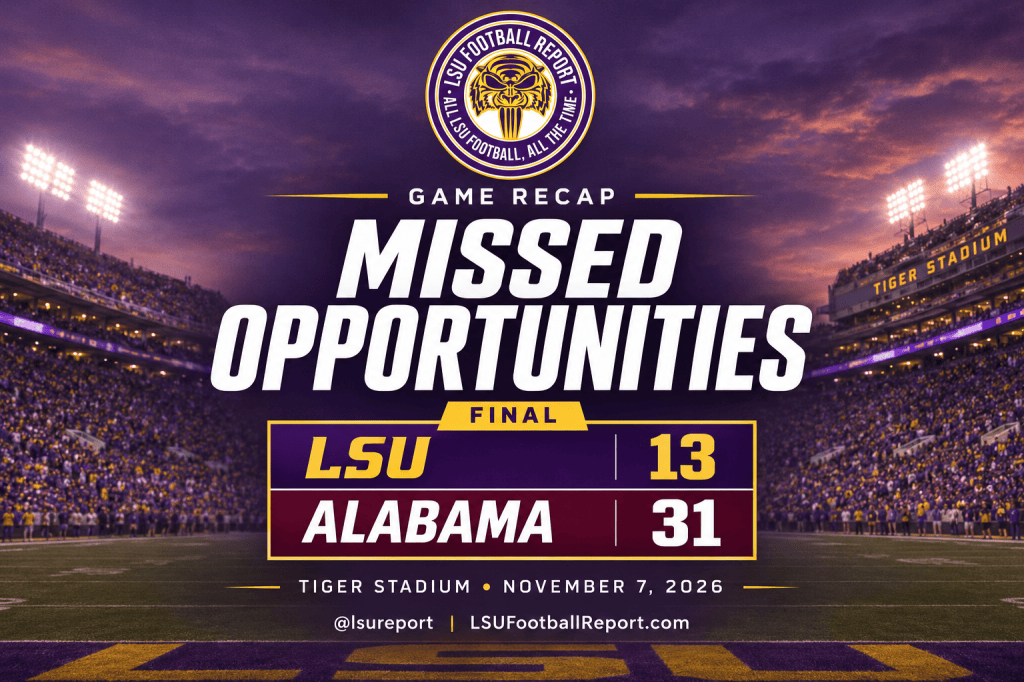
LSU had the football, the yardage and a third quarter lead. What the Tigers could not produce were the points needed to finish the job.
Alabama defeated LSU 31 to 13 on Saturday at Tiger Stadium, handing the Tigers a frustrating loss in a game they had opportunities to control. LSU generated 457 yards of offense, but too many promising possessions ended without a score.
The Tigers fell to 6 and 3 overall and 3 and 3 in SEC play. Alabama improved to 7 and 2 and 5 and 2 in the conference, leaving LSU with another difficult November challenge when Texas visits next Saturday.
The Yardage Was There. The Finishing Was Not.
LSU outgained Alabama 457 yards to 285 and finished with 27 first downs compared with the Tide’s 13. The Tigers moved the football well enough to make this a very different game.
The difference came when possessions reached their most important moments. LSU failed on all four fourth down attempts, allowing Alabama to repeatedly stop drives without surrendering points.
That was the most frustrating part of the afternoon. LSU could create opportunities against Alabama’s defense, but the Tigers could not consistently turn those opportunities into touchdowns. Every empty possession gave the Tide another chance to stay ahead.
Leavitt and Harris Produce Through the Air
Sam Leavitt completed 35 of 47 passes for 380 yards, with no touchdown passes and one interception. Jackson Harris remained his most productive target, catching 11 passes for 166 yards.
Those numbers showed that LSU could find openings through the air. They also captured the disconnect between moving the ball and finishing possessions, as a substantial passing performance produced no passing touchdowns.
Trey’Dez Green added 10 receptions for 85 yards, while Dilin Jones caught seven passes for 36 yards. Jones also supplied LSU’s only touchdown and led the Tigers with 56 rushing yards on 17 carries.
The running game never gave LSU consistent balance. The Tigers finished with 77 rushing yards on 33 attempts, an average of 2.3 yards per carry that included losses from four sacks.
Missed Chances Keep LSU Behind at Halftime
Alabama opened the scoring with a 43 yard field goal from Conor Talty. LSU answered with a 23 yard field goal from Scott Starzyk, but the Tigers could not build on that opening scoring possession.
Starzyk missed from 56 yards early in the second quarter. Alabama later moved ahead 10 to 3 on a one yard rushing touchdown by Ryan Coleman-Williams, leaving LSU chasing points despite its ability to advance the football.
LSU had additional chances before halftime. A fourth down possession ended inside Alabama’s 10 yard line, and another drive ended with an interception as the Tigers tried to cut into the deficit.
Those opportunities were expensive to waste. LSU reached halftime trailing by a touchdown when it had done enough between the 20s to put considerably more pressure on Alabama.
Jones Gives LSU a Lead
The Tigers responded after the break. Starzyk made a 41 yard field goal to pull LSU within 10 to 6, and Jones later scored from five yards out to give the home team a 13 to 10 lead.
With 2:44 remaining in the third quarter, LSU had finally turned its offensive movement into the advantage on the scoreboard. The game was there for the Tigers to take.
Alabama answered immediately. Keelon Russell connected with Rico Scott for a 57 yard gain on the opening play of the next possession, and the Tide finished the drive with a seven yard touchdown pass to Josh Ford.
LSU’s lead lasted just over two minutes. Alabama entered the fourth quarter ahead 17 to 13, having erased the momentum the Tigers had worked so hard to create.
The Fourth Quarter Slips Away
A 32 yard punt return by Coleman-Williams gave Alabama possession at LSU’s 25. Russell found Cederian Morgan for a touchdown on the next play, extending the lead to 24 to 13.
LSU then failed on fourth down from its own 18, giving Alabama another short field. Russell’s four yard touchdown pass to Kaleb Edwards pushed the margin to 31 to 13 and completed a run of 21 unanswered points.
Those short fields helped turn a competitive game into a decisive final score. LSU’s defense limited Alabama’s overall production, but the Tigers could not protect their brief lead or prevent the plays that changed field position.
Russell finished with 206 passing yards and three touchdowns without an interception. Alabama made its most important possessions count, which was precisely what LSU struggled to do.
Texas Becomes the Next Test
LSU returns to Tiger Stadium on November 14 to face Texas in its final home game of the regular season. The Tigers must regroup quickly after a loss that made their path through November considerably harder.
There was enough offensive production Saturday to show what LSU can do. Harris continued to deliver, Leavitt found receivers throughout the afternoon, and the Tigers put themselves in position to win.
But yards alone could not rescue this performance. LSU needed touchdowns, critical conversions and a response after taking the lead. Against Alabama, those were the moments that decided the game.
Sources
LSU Athletics official game recap and final game book; WBRZ game report; Tiger Rag postgame coverage; SECFootball.co final statistical recap; LSU Athletics schedule.

