
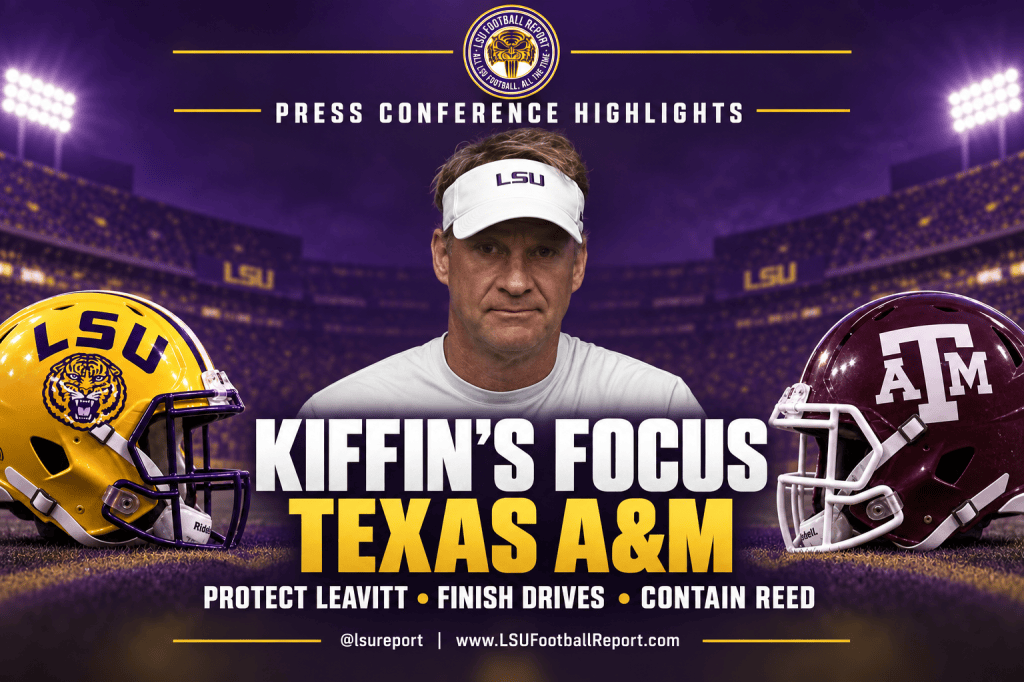
Lane Kiffin’s review of LSU’s loss at Ole Miss produced frustration, but also a clear list of opportunities. The Tigers had chances to change the outcome, and their preparation for Texas A&M now centers on making those opportunities count.
During Monday’s press conference, Kiffin addressed quarterback confidence, offensive line play, passing efficiency, defending Marcel Reed, missed scoring chances and the team’s emotional response. His comments offered a detailed picture of what LSU must improve before returning to Tiger Stadium.
The No. 10 Tigers host No. 23 Texas A&M on Saturday, September 26. Both teams enter at 2–1 after losing their SEC openers.
Kiffin acknowledged the emotional weight of the Ole Miss game. Reviewing the film brought renewed disappointment because players could see where a different decision or better execution might have changed the result. LSU’s task is to use that frustration productively during practice.
The offensive line is a central part of that response. Asked where improvement was needed, Kiffin gave a direct answer: “Pass protection, too many breakdowns in 1-on-1 matchups.”
He viewed the run blocking more favorably, giving LSU something to build on. The challenge is providing comparable dependability when Leavitt drops back to throw.
Kiffin had already raised the possibility of adjustments during his Sunday media availability.
“We’re going to look at some different things this week up front,” he said.
That leaves room for changes without establishing a new starting lineup. The practical requirement is clear: LSU needs fewer protection breakdowns and more chances for its quarterback to execute the called play.
Leavitt’s pocket confidence was another important subject. Kiffin explained how early pressure can affect a quarterback beyond the plays on which defenders reach him. Once a passer starts anticipating trouble, he can leave the pocket before a route develops.
Kiffin wants Leavitt to maintain his running threat while becoming more patient when protection allows it. LSU benefits when he escapes genuine pressure, but it also needs him to recognize opportunities to stay set and deliver the football.
The passing game’s problems extend beyond protection. Kiffin discussed the need for more consistent completions and fewer unproductive plays. A completed pass can gain yardage, establish rhythm and force defenders to pursue across the field. Repeated incompletions accomplish none of those things.
For LSU, the next step does not always require a spectacular throw. Taking an available completion can keep a possession moving and create better opportunities later.
Finishing drives received attention, too. In the published press conference account, Kiffin described a missed block that prevented a potential touchdown even though the running play still gained five yards.
He called such missed opportunities “four-point plays,” referring to the difference between a touchdown with an extra point and a field goal. That distinction explains why a play that looks reasonably successful can still be costly on film.
LSU must turn more favorable situations into touchdowns. Near the end zone, a single assignment can determine whether a drive delivers its full reward.
Defensively, Reed presents a specific test of discipline. Kiffin cautioned that success against conventional rushing attacks does not automatically prepare a defense for designed quarterback runs.
“This is a big test,” he said.
Reed’s mobility requires defenders to maintain their responsibilities throughout the play. An aggressive rush can help LSU, but an opening between rushers can also give the quarterback a path out of trouble. The Tigers need pressure that works with their coverage and containment.
Personnel depth remains part of the preparation. The published account also included Kiffin’s praise for the backup quarterbacks’ work in practice and their game opportunities. Their readiness matters even when the offense is being built around Leavitt.
Injuries add urgency to that broader depth discussion. CBS Sports reported that Dashawn Spears suffered a season-ending ACL injury, while Trey’Dez Green was expected to miss time following his knee injury.
In his Sunday comments, Kiffin explained why replacing Spears involves more than filling a position on the depth chart.
“Spears is really unique and has the ability to play in a lot of the defenses,” he said.
Spears’ versatility gave LSU options. Preparing the next players to handle those responsibilities is now part of the defensive staff’s work, while Green’s absence would require adjustments to the offense.
Kiffin also addressed the atmosphere at Tiger Stadium. Asked how LSU could prevent visiting fans from becoming a prominent presence, his answer was straightforward: “By winning and getting up.”
The crowd can contribute, but the players must give it reasons to stay involved. A strong start and sustained execution would help LSU make its home setting an advantage.
Inside the football facility, the shift toward Texas A&M is already deliberate. Kiffin explained that upcoming opponents’ highlights appear on televisions to keep players focused on their next assignment, a routine LSU follows after wins and losses.
Saturday provides an immediate opportunity to put that preparation to work. LSU does not need to solve every problem with one spectacular play. Better protection, dependable completions, disciplined defense and finished drives would give the Tigers a much stronger chance to leave the field with a victory.
Kickoff is scheduled for 6:30 p.m. Central on ABC.
Sources
- LSU Football Report — September 21 press conference account
.
- TigerDroppings — Monday press conference highlights and quotations
.
- SEC — Kiffin on defending Reed and developing Leavitt’s pocket confidence
.
- Louisiana Sports — Kiffin’s Sunday comments on possible offensive line changes
.
- Field Level Media — Spears and Green injury reporting and Kiffin’s comments
.
- TigerBait — Matchup, rankings and kickoff information
.

